Weight Loss Drugs Are Doing More Than Anyone Expected — Here’s What the Research Actually Shows

Ozempic. Wegovy. Mounjaro. Names that barely existed five years ago now appear in casual conversation the way “beta-blocker” or “statin” does. Ask around your own friends, colleagues, and neighbours over 50 and the numbers might surprise you — a genuinely significant portion have either tried one of these drugs, are considering trying them, or know someone whose life they’ve quietly changed. Global GLP-1 use in adults without diabetes jumped by more than 600% between 2017 and 2022, and the growth has continued sharply since.
However, the story that’s landed in the culture is largely about weight loss. What’s happening in the research is considerably more interesting than that. Because these drugs, it turns out, aren’t just doing what they were designed to do — they appear to be doing considerably more, in ways that could reshape how we think about metabolic health, cardiovascular risk, and even biological ageing itself.
This isn’t a piece telling you whether to take one. It’s a piece explaining what the science is showing — including the parts that are genuinely encouraging, and the important parts that are being underplayed.
⚡ What You’ll Learn in the Next 5 Minutes
- What GLP-1 drugs actually do in the body — and why the effects reach so far beyond appetite
- The cardiovascular, kidney, and liver benefits that go well beyond weight loss
- The emerging longevity research that’s genuinely surprising
- The single biggest risk almost nobody talks about — and how to protect against it
- The questions worth asking before you consider one yourself
What They Actually Do — The Science Made Simple
GLP-1 stands for “glucagon-like peptide-1” — a hormone your gut naturally releases when you eat. Its job is essentially to slow things down. It slows the rate at which your stomach empties, so you feel fuller for longer. It signals your brain to reduce appetite. It increases insulin release in response to rising blood sugar, and reduces glucagon (which normally raises blood sugar). It’s a coordinated brake pedal on the entire eating-and-blood-sugar system.
The drugs — semaglutide, tirzepatide, liraglutide and others — are synthetic versions of this hormone, engineered to last considerably longer in the body than the natural version and delivered by weekly injection or, increasingly, daily oral tablet. Tirzepatide takes things further by also mimicking a second gut hormone called GIP, which is why it consistently produces larger effects than semaglutide.
The weight loss numbers are genuinely dramatic. Semaglutide produces average weight loss of around 15% of body weight over 68 weeks. Tirzepatide averages around 20-22.5% — approaching the results previously only seen with bariatric surgery. For context, most previous generations of weight-loss drug produced 3-5% at best. This is a genuine step-change in what pharmacology can do.
However, the reason to pay attention isn’t the weight loss. It’s what else is happening at the same time.
Cardiovascular Benefits Beyond What Weight Loss Alone Would Explain
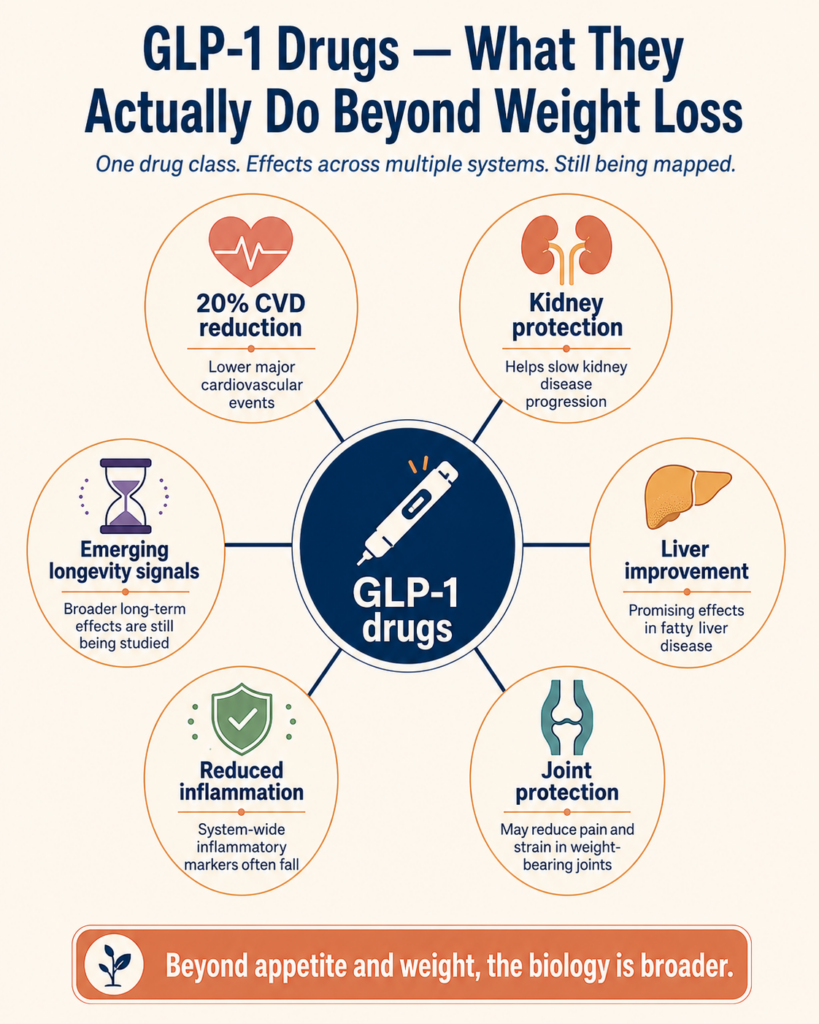
The most robust “hidden benefit” of GLP-1 drugs is cardiovascular. The landmark SELECT trial, published in the New England Journal of Medicine, followed more than 17,000 people with existing cardiovascular disease and overweight or obesity (but without diabetes). Those taking semaglutide had a 20% reduction in major cardiovascular events — heart attacks, strokes, and cardiovascular deaths — over a follow-up period averaging around three years.
Critically, the researchers analysed this and concluded that the cardiovascular benefit wasn’t simply a function of the weight loss. The drug appeared to be doing something independently — likely a combination of reduced inflammation, improved blood vessel function, better blood pressure control, and improved cholesterol profiles. Similar cardiovascular protective effects have been shown in the LEADER trial (liraglutide) and REWIND trial (dulaglutide).
This matters enormously in the context of longevity thinking. Cardiovascular disease remains the leading cause of death in the UK and most of the developed world. Any intervention that reduces cardiovascular event risk by 20%, over and above whatever weight loss contributes, is genuinely significant. For people whose cardiovascular risk profile is already elevated, this is the kind of number that changes how the risk-benefit calculation looks. It also throws a slightly different light on the wider conversation about cholesterol and prevention, which we’ve written about in our piece on the statin conversation your GP didn’t have time for. GLP-1s and statins increasingly look like they might work through overlapping mechanisms — reducing systemic inflammation and improving vascular health — with the GLP-1 drugs producing broader metabolic effects on top.
Liver, Kidney, and Joint Benefits — A Rapidly Growing List
The wider benefits keep accumulating. The ESSENCE trial, presented in late 2024, showed that semaglutide significantly reduced liver fibrosis in patients with metabolic dysfunction-associated steatohepatitis (MASH) — the more serious progression of what used to be called non-alcoholic fatty liver disease. This is a condition affecting an estimated 5-10% of UK adults and until now has had essentially no effective drug treatment. If the results hold up in ongoing trials, semaglutide could become the first approved medication for a condition that increases risk of liver failure and cancer.
Kidney disease is another area where the benefits appear substantial. Multiple trials have now shown reduced progression of chronic kidney disease and reduced kidney-related deaths in people taking GLP-1 drugs. This matters particularly for people with type 2 diabetes, in whom kidney disease is one of the most significant complications.
Osteoarthritis of the knee — one of the most common causes of mobility loss in later life — is another area where recent research suggests real benefit. A 2025 study found reduced risk of knee replacement surgery in people on GLP-1 drugs, even after adjusting for weight loss. The likely mechanism is reduced inflammation in the joint tissues themselves. Given the compounding effects of chronic inflammation on ageing — which we’ve explored in our piece on how to reduce inflammation naturally — the anti-inflammatory action of these drugs may turn out to be one of their most important long-term effects.
Perhaps most intriguingly, small early studies in HIV patients have suggested that semaglutide may actually slow markers of biological ageing itself — reducing measurable inflammatory markers and improving cellular function. These findings are preliminary and need much larger trials to confirm. However, they open up the genuinely fascinating possibility that GLP-1 drugs may act on biological ageing pathways directly, not just via weight and metabolic effects.
The Muscle Problem Nobody’s Talking About Enough
Now for the important cautionary section, because it deserves emphasis.
When you lose significant amounts of body weight rapidly through appetite suppression, you don’t just lose fat. You also lose muscle. Studies of GLP-1 drug users suggest that between 25% and 40% of total weight lost is lean muscle mass, depending on the specifics of the person and the protocol. That’s a genuinely alarming number for anyone over 50, because muscle loss after 50 is already a significant health issue — one we’ve explored at length in our piece on muscle loss after 50.
Losing muscle isn’t just a cosmetic problem. Muscle is metabolically active tissue — it burns calories at rest, regulates blood sugar, supports bone density, and protects against falls. Rapid muscle loss in later life accelerates almost everything about biological ageing that most people are actively trying to slow. It also creates a specific and particularly nasty problem: when people stop taking GLP-1 drugs (which most eventually do, whether by choice or necessity), they tend to regain weight rapidly — but predominantly as fat, not as muscle. The net result can be a worse body composition than before starting.
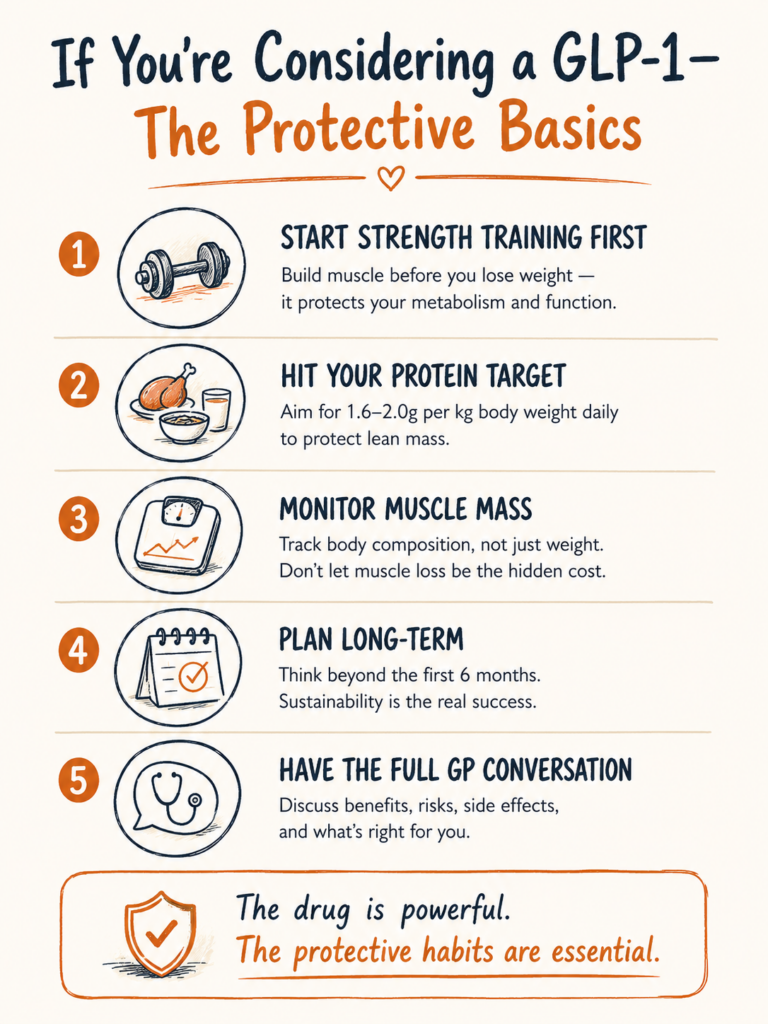
The single most important thing anyone taking these drugs can do, in my view, is to combine them with serious resistance training and adequate protein intake. This isn’t optional advice. It’s essential. Multiple studies have now shown that resistance training during GLP-1-mediated weight loss preserves significantly more muscle mass — and the addition of adequate dietary protein amplifies the effect further.
The practical implication is stark. If someone in their 50s or 60s is considering a GLP-1 drug, they should be starting resistance training before starting the drug, not after. Two 45-minute sessions a week, focused on compound movements — squats, deadlifts, rows, presses. Adequate protein throughout the day, ideally 1.6-2.2 grams per kilogram of body weight, distributed across meals. Our companion pieces on strength training after 50 and the role of protein in ageing cover the practical details.
Without these two protective measures, the potential benefits of GLP-1 drugs are significantly undermined by what may become long-term losses in strength, bone density, and functional independence. This is genuinely the most important thing to understand about these drugs for anyone over 50.
The Other Genuine Considerations
Alongside the muscle question, there are other things worth understanding honestly before considering these drugs.
Gastrointestinal side effects are extremely common — nausea, constipation, and reduced appetite that some people find deeply uncomfortable. Most improve as the body adjusts, but some don’t, and about 10-15% of people discontinue for this reason.
The rebound question is real. When people stop taking GLP-1 drugs, weight typically returns — sometimes fully within a year. The current medical consensus is increasingly that obesity, like hypertension, should be understood as a chronic condition requiring ongoing management, not a one-time fix. Taking these drugs may therefore be a long-term commitment, not a short-term intervention.
Cost and access remain significant. On the NHS, GLP-1 drugs for weight management are only available through specialist weight management services and only for people with a BMI of 35 or above (or 30 with obesity-related conditions). Private prescriptions are widely available but cost around £150-£250 per month.
Long-term safety data beyond around 5-7 years is still limited. The class has been in extensive clinical use for well over a decade in diabetes care, and the safety picture is broadly reassuring. However, for people considering multi-decade use starting in their 50s, some genuine uncertainty remains about very long-term effects.
| Consideration | What the Evidence Shows |
|---|---|
| Weight loss | ✅ 15-22% average, sustained with continued use |
| Cardiovascular event reduction | ✅ 20% reduction in major CVD events, independent of weight loss |
| Liver disease (MASH) | ✅ Significant improvement in fibrosis (semaglutide) |
| Kidney protection | ✅ Reduced progression of chronic kidney disease |
| Muscle mass preservation | ⚠️ 25-40% of weight lost is muscle — requires active mitigation |
| Weight regain on stopping | ⚠️ Substantial regain typical — likely a lifelong medication |
| GI side effects | ⚠️ Common; usually manageable but sometimes not |
| Long-term safety (10+ years) | ⚠️ Reassuring so far, but genuinely still emerging |
Where This Fits in the Longevity Picture
It’s worth taking a step back for a moment, because there’s a genuine risk that the astonishing efficacy of these drugs makes it easy to forget the wider context.
The fundamentals of healthy ageing haven’t changed. Strength training, adequate protein, quality sleep, social connection, sensible sun exposure, and not smoking remain the foundation. GLP-1 drugs, however impressive, don’t replace any of this. They may, for some people, become a powerful additional tool sitting on top of that foundation — but they don’t substitute for it. Anyone who takes them and neglects the fundamentals will experience a significantly worse net result than someone who does both.
What’s exciting about the emerging science is the possibility that GLP-1s may act on biological ageing pathways directly — reducing inflammation, improving cellular function, protecting cardiovascular and metabolic systems. If those effects continue to be validated in larger trials, we may look back on this decade as the point at which pharmacology first began to address ageing biology directly rather than just its symptoms. However, we’re not there yet. The evidence is promising and growing, but it’s still emerging. The wider work of slowing biological ageing naturally continues to be the sensible focus for most people.
For anyone considering these drugs specifically, our piece on the health checks worth asking for after 50 covers how to have the informed conversation with your GP — and what baseline testing genuinely makes sense before starting a significant new medication.
FAQ — Things People Actually Ask
Are these drugs safe for long-term use?
The best current answer is “probably, with reasonable confidence up to about 7 years, and with genuine uncertainty beyond that.” The GLP-1 drug class has been in extensive clinical use since 2005 in diabetes care, and the safety picture across that time is broadly reassuring. However, the very high doses used specifically for weight management, in non-diabetic populations, over multi-decade periods, remain a genuine unknown. This isn’t a reason to avoid them if the potential benefits are substantial for you. It is a reason to have the full conversation with your GP and be aware that some genuine uncertainty exists.
Can I get one on the NHS?
On the NHS, GLP-1 drugs for weight management are currently only available through specialist weight management services and only for adults with a BMI of 35 or above (or 30 with obesity-related conditions like type 2 diabetes, high blood pressure, or sleep apnoea). Referral is typically via your GP. For those who don’t meet the threshold or don’t want to wait, private prescriptions are widely available but typically cost £150-£250 per month, and this is likely to be a long-term expense given the rebound issue.
What happens when I stop taking them?
Without ongoing support, weight regain is significant — typically at least half of the weight lost within a year, sometimes more. This is not a failure of willpower — it’s the biology reverting to its previous set-point. The current medical consensus is increasingly to treat obesity as a chronic condition requiring long-term management, in the same way we treat high blood pressure or cholesterol. This is worth understanding clearly before starting, so the decision is fully informed.
What’s the single most important thing I can do this week?
If you’re currently taking a GLP-1 drug and not doing serious resistance training, start this week. Two 45-minute sessions of compound movements, and 1.6-2.2 grams of protein per kilogram of body weight distributed across meals. This is not optional. It’s the single biggest thing that determines whether these drugs work for your long-term health or against it. And if you’re considering starting a GLP-1 drug, begin the strength training and protein habits at least a month before your first dose — you’ll be significantly better positioned to preserve muscle and function through the weight loss period.
One Thing to Do This Week
Whether you’re taking a GLP-1 drug, considering one, or just curious about the science, take one small action: read the label on the protein content of your breakfast. Most people over 50 are dramatically under-eating protein — regardless of what else they’re doing about weight or medication. Adequate protein is the single most protective habit against muscle loss, whatever else is happening in your life. If you’re not currently hitting 20-30 grams at breakfast, that’s the first fix. It costs nothing, it’s completely under your control, and it matters more than almost any other intervention available to you.
Want to Go Deeper?
If this has prompted you to think differently about weight, muscle, and the broader picture of what actually keeps you healthy over the long term, we’ve put together guides covering the practical building blocks of healthy ageing — nutrition, strength, sleep, and beyond.
Browse the full guides library at Slowing the Clock →
Take what’s useful. Leave what isn’t. That’s always the idea.