The Health Checks Worth Asking For — Even If Nobody’s Offered Them

The NHS is genuinely good at many things. Proactively telling you about every health check you’re entitled to — or could benefit from — is not always one of them. Some screenings arrive automatically through the post. Others require you to know they exist, know you’re eligible, and know to ask. And a handful are available to you right now, today, if you simply request them — but will never be mentioned unless you do.
At 50, 55, 60 — this stuff starts to matter in a way it simply didn’t before. The cancers most likely to affect your age group are also among the most treatable when caught early. The cardiovascular risks quietly building in your 50s are largely preventable if identified in time. However, none of that applies if you’re sitting at home assuming someone will write to you when the moment comes.
This is your guide to what’s available, what to ask for, and what to say when you ask.
⚡ What You’ll Learn in the Next 5 Minutes
- Which NHS screenings you’re automatically enrolled in — and which ones you aren’t
- The PSA test most men don’t know they can request today
- The single blood test worth asking your GP for at every annual review
- Why catching things early genuinely changes outcomes — with the numbers to prove it
- Exactly what to say to your GP to get the checks you need
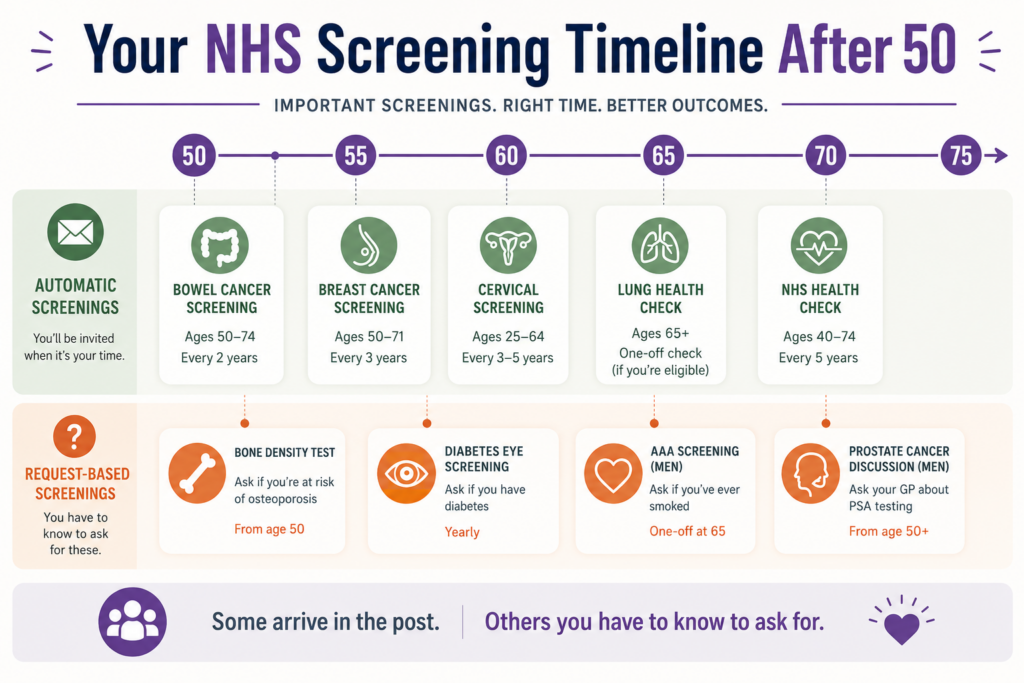
First — What the NHS Actually Screens For Automatically
Let’s start with what you do get without asking. The NHS runs several national screening programmes that invite people automatically based on age and, in some cases, sex. Knowing what’s included — and crucially, what isn’t — is the foundation of everything else.
| Screening | Who It’s For | How Often | Automatic Invite? |
|---|---|---|---|
| Bowel cancer screening | Everyone aged 50–74 | Every 2 years | ✅ Yes — home kit by post |
| Breast cancer screening | Women aged 50–70 | Every 3 years | ✅ Yes — letter from NHS |
| Cervical screening | Women aged 25–64 | Every 3–5 years | ✅ Yes — letter from NHS |
| Abdominal aortic aneurysm (AAA) | Men aged 65 | One-time scan | ✅ Yes — automatic at 65 |
| NHS Health Check | Everyone aged 40–74 | Every 5 years | ⚠️ Should be invited — but gaps exist |
| PSA test (prostate cancer) | Men aged 50+ | On request | ❌ No — you must ask |
| Diabetic eye screening | People with diabetes | Annual | ✅ Yes — if diabetic |
The important pattern here: most of what the NHS offers automatically is cancer screening. What it does not routinely offer is metabolic screening, hormonal profiling, or prostate cancer testing. Those require you to ask — and knowing how to ask is half the battle.
The PSA Test — The One Most Men Don’t Know About
This is the most important section for men in your audience to read carefully, because it involves a decision rather than simply booking an appointment.
Prostate cancer is the most common cancer in men in the UK. Around 52,000 men are diagnosed each year, and it kills around 12,000. However, unlike bowel or skin cancer, there is no automatic national screening programme for it. The reason is genuinely complicated — the PSA (prostate-specific antigen) blood test is imperfect. It produces false positives that lead to unnecessary anxiety and sometimes unnecessary treatment. That is a real limitation, and it’s why the NHS hasn’t rolled out universal screening.
However — and this is the part that matters — any man aged 50 or over can request a PSA test from their GP today, without symptoms, without a referral, without any specific reason beyond wanting to know. This is NHS policy. It is called the Prostate Cancer Risk Management Programme, and it exists precisely to give men who want testing the right to have it.
Before requesting the test, you should understand what a result means — because a raised PSA does not automatically mean cancer, and a normal PSA does not guarantee its absence. Your GP should discuss this with you before the test. If they don’t, ask them to. The decision to test is yours to make, but it should be an informed one.
What to say to your GP: “I’m over 50 and I’d like to discuss having a PSA test under the Prostate Cancer Risk Management Programme.” Those words specifically. They signal that you know your entitlement and are making an informed request.
The NHS Health Check — Worth Chasing If You Haven’t Had One
Everyone between 40 and 74 who is not already being treated for certain conditions is entitled to a free NHS Health Check every five years. It covers blood pressure, cholesterol, BMI, blood sugar, and cardiovascular risk. In theory, your GP surgery should invite you automatically. In practice, the system has significant gaps — many practices are inconsistent about sending invitations, and many people fall through without realising.
Therefore, if you are in this age bracket and cannot remember having had one in the last five years, call your GP surgery and ask for one. You do not need a reason. You do not need symptoms. You are simply entitled to it.
The NHS Health Check is particularly valuable as a baseline. Knowing your numbers — your blood pressure, your cholesterol ratio, your HbA1c — gives you something to track over time and something concrete to act on. Many of the lifestyle interventions that most reliably reduce cardiovascular risk, including the kind of evidence-based approaches to slowing biological ageing we write about on this site, work considerably better when you know your starting point.
Blood Tests Worth Asking For — Beyond the Basics
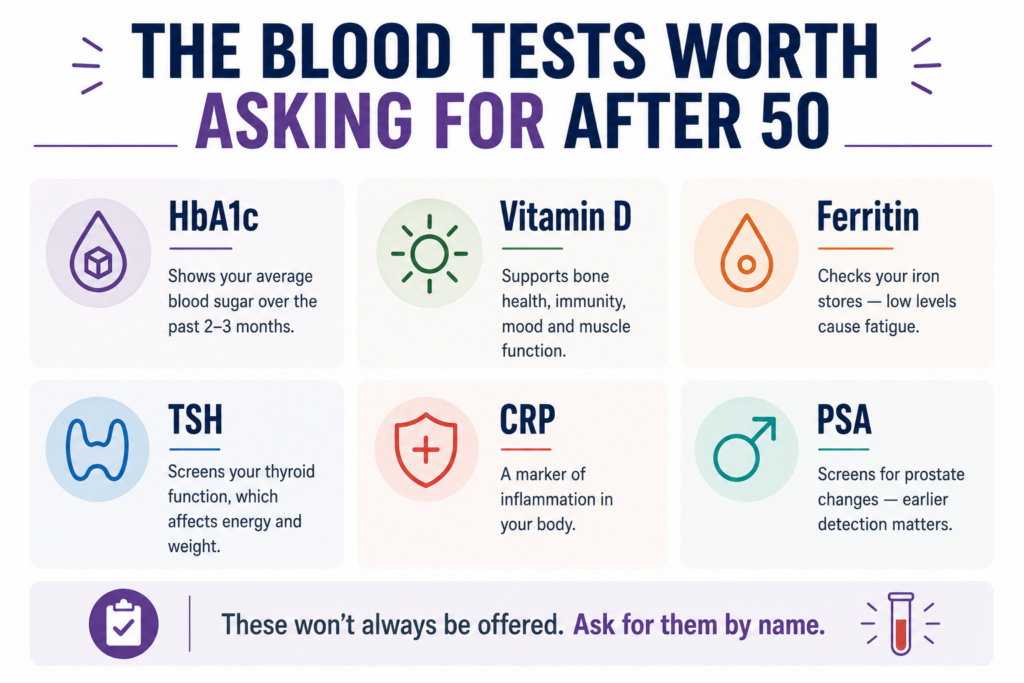
The NHS Health Check covers the fundamentals. However, there are additional blood markers that are genuinely worth knowing — particularly for people in their 50s and 60s — that won’t be included unless you ask.
HbA1c (blood sugar over time). This is the gold standard marker for pre-diabetes and type 2 diabetes risk. Unlike a fasting glucose test, it reflects your average blood sugar over the previous three months, making it far harder to game with a good day’s eating beforehand. If you’re over 50, carrying any extra weight around the middle, or have a family history of type 2 diabetes, this is worth requesting specifically.
Vitamin D. Deficiency is extremely common in the UK — estimates suggest up to 1 in 5 adults have low levels — and the consequences for muscle function, immune health, bone density, and mood are well-documented. Your GP may or may not include this in a standard panel. Ask specifically if you want to know.
Ferritin (iron stores). Particularly relevant for women approaching or going through menopause, low ferritin is a common and commonly missed cause of fatigue, poor concentration, and reduced exercise capacity. It is not the same as anaemia, and many GPs will only test haemoglobin without checking ferritin unless asked.
Thyroid function (TSH). Thyroid issues become increasingly common after 50, particularly in women, and the symptoms — fatigue, weight changes, low mood, feeling cold — are easily attributed to other things. A simple TSH blood test screens for both overactive and underactive thyroid and is well worth including in any blood panel review.
Inflammatory markers (CRP/ESR). Low-grade chronic inflammation is one of the most significant drivers of accelerated biological ageing. A high-sensitivity CRP test gives you a snapshot of systemic inflammation levels. If elevated, it’s a powerful motivator to look at diet, sleep, stress, and exercise — areas where evidence-based lifestyle changes make a measurable difference. Our piece on how to reduce inflammation naturally covers the most effective approaches in detail.
Before loading up on supplements based on any of these results, it’s also worth reading what the evidence actually says — our review of multivitamins and longevity is a useful starting point for separating the genuinely evidence-backed from the marketing noise.
Why Early Detection Actually Changes Outcomes
It can feel abstract — the idea that a test you take today, when you feel fine, could matter years from now. However, the data on this is unambiguous and worth sitting with for a moment.
Bowel cancer detected at Stage 1 has a five-year survival rate of around 90%. Detected at Stage 4, that drops to approximately 10%. The cancer biology hasn’t changed — the timing of detection has. Breast cancer, prostate cancer, and cervical cancer follow similar patterns. The treatment is less aggressive, the outcomes are better, and the quality of life during treatment is significantly higher when detection happens early.
The same principle applies to metabolic health. Pre-diabetes identified through an HbA1c test is almost entirely reversible through lifestyle intervention — diet, exercise, and sleep quality being the three most powerful levers. Left undetected and unaddressed, it typically progresses to type 2 diabetes within five to ten years, with significantly more complex consequences. The window where intervention is easy and highly effective is exactly the window that regular screening is designed to catch.
Poor sleep, incidentally, is one of the most underappreciated drivers of insulin resistance and cardiovascular risk. If your NHS Health Check flags elevated blood sugar or blood pressure, it is worth reading our piece on the importance of sleep for longevity alongside any dietary changes — the two are more connected than most people realise.
What to Actually Say to Your GP
GPs are busy. Appointments are short. The path of least resistance in a ten-minute slot is to address whatever you came in for and move on. However, if you are prepared and specific, most GPs will respond positively to a patient who clearly knows what they want and why.
Here are the exact phrases worth having ready:
- “I’d like to request a PSA test — I understand I’m entitled to one under the Prostate Cancer Risk Management Programme.”
- “I haven’t had an NHS Health Check in the last five years — can we arrange one?”
- “When you run my blood panel, could you include HbA1c, Vitamin D, ferritin, TSH, and a high-sensitivity CRP?”
- “I’d like to discuss my cardiovascular risk score — can we go through my numbers together?”
None of these requests is unreasonable. All of them are within standard NHS provision. The key is asking specifically rather than generally — “can I have some blood tests done” is easy to deflect; a named list of markers is considerably harder to dismiss.
FAQ — Things People Actually Ask
My GP seems reluctant to do extra tests — what should I do?
Stay calm and be specific. Reference the programme or entitlement by name where relevant — particularly for the PSA test. If you feel your request is being unreasonably declined, you are entitled to ask for a second opinion or speak to the practice manager. Most reluctance from GPs around extra testing relates to time and resource pressures, not a belief that the tests are unimportant — a clear, specific, informed request usually resolves it.
Should I go private for screening if I can afford to?
For some tests — full hormonal panels, DEXA bone density scans, advanced lipid profiling — private health checks can give you considerably more data than the NHS routinely provides. However, the fundamentals covered here are all available on the NHS. Private screening is a useful supplement, not a replacement, and the most important step is making full use of what you’re already entitled to before spending money on extras.
I feel completely fine — do I really need to do this?
Yes — and this is precisely the point. The conditions most worth catching early are largely asymptomatic in their early stages. You will not feel a bowel polyp developing. You will not feel pre-diabetes. You will not feel a prostate cancer growing slowly for years before it causes any noticeable symptoms. Feeling fine is genuinely good news, but it is not the same as knowing you are well.
What’s the single most important thing I can do this week?
Call your GP surgery and book an NHS Health Check if you haven’t had one in the last five years. That single appointment will give you your blood pressure, cholesterol, blood sugar, and cardiovascular risk score — a baseline for everything else. If you’re a man over 50 who has never had a PSA conversation with your GP, add that to the same appointment. Two things. One phone call.
One Thing to Do This Week
Call your GP surgery today and ask when you last had an NHS Health Check. If it’s been more than five years — or you’ve never had one — book it now. Take this article with you if it helps. You are not being a hypochondriac. You are being someone who understands that prevention is easier, cheaper, and considerably less frightening than treatment.
Want to Go Deeper?
Knowing your numbers is the first step. Knowing what to do with them is the next. We’ve put together guides on the lifestyle interventions with the strongest evidence behind them — covering everything from inflammation and metabolic health to sleep and nutrition.
Browse the full guides library at Slowing the Clock →
Take what’s useful. Leave what isn’t. That’s always the idea.