Walking Pace: The Surprisingly Powerful Predictor of How Long You’ll Live

Here’s something remarkable, and slightly unsettling, that longevity researchers have known for years but somehow rarely reaches the wider conversation. The speed at which you walk down the street — your normal, everyday, not-trying-to-catch-a-bus walking pace — is one of the most accurate predictors we have of how long you’ll live. More accurate, in some studies, than cholesterol. More accurate than blood pressure. Nearly as accurate as combining several traditional risk factors into a single score.
That sounds like an exaggeration. It isn’t. Researchers now describe walking speed as a kind of biological summary — a single number that captures the working state of your muscles, your heart, your lungs, your nervous system, and your brain, all reporting at once. When you walk slowly without meaning to, something in that system is telling on you. And when you walk with easy, confident pace into your 60s and 70s, that’s telling on you too — in a much better way.
The best part? This isn’t a fixed measurement. You can improve it.
⚡ What You’ll Learn in the Next 5 Minutes
- Why walking pace predicts longevity better than most tests your GP orders
- The exact walking speeds that correlate with longer life — and how to measure yours
- What’s actually being measured when you walk at your normal pace
- The surprising connection between walking speed and dementia risk
- How to train faster walking without turning it into a chore
The Evidence — And Why It’s Remarkable
The most influential study on this came out of the University of Pittsburgh, where researchers pooled data from nine long-term studies covering nearly 35,000 adults over 65. What they found was startling. For every 0.1 metres per second faster someone walked at their usual pace, mortality risk dropped by roughly 12%. The relationship held across every age group, both sexes, and after controlling for the usual suspects — smoking, blood pressure, existing conditions.
However, one of the most important studies for our purposes was done on people your age. The Whitehall II cohort study — a long-running project tracking British civil servants — measured walking speed in more than 6,000 middle-aged adults (average age 61) and followed them for six years. Participants in the slowest third had roughly double the mortality risk of those in the middle and top thirds combined. The finding held after controlling for socioeconomic status, cardiovascular risk factors, chronic conditions, cognitive function, and inflammatory markers.
That’s what makes walking speed so powerful as a predictor. It isn’t measuring one thing. It’s measuring everything at once. To walk at a brisk, confident pace requires functioning muscles, good cardiovascular capacity, working joints, an intact nervous system, and a brain that’s coordinating all of it smoothly. When any of those systems start to falter — even before you notice it consciously — your walking speed drops. Because walking is such an ordinary, everyday act, most people don’t notice their own decline until it becomes significant.
The Numbers That Actually Matter
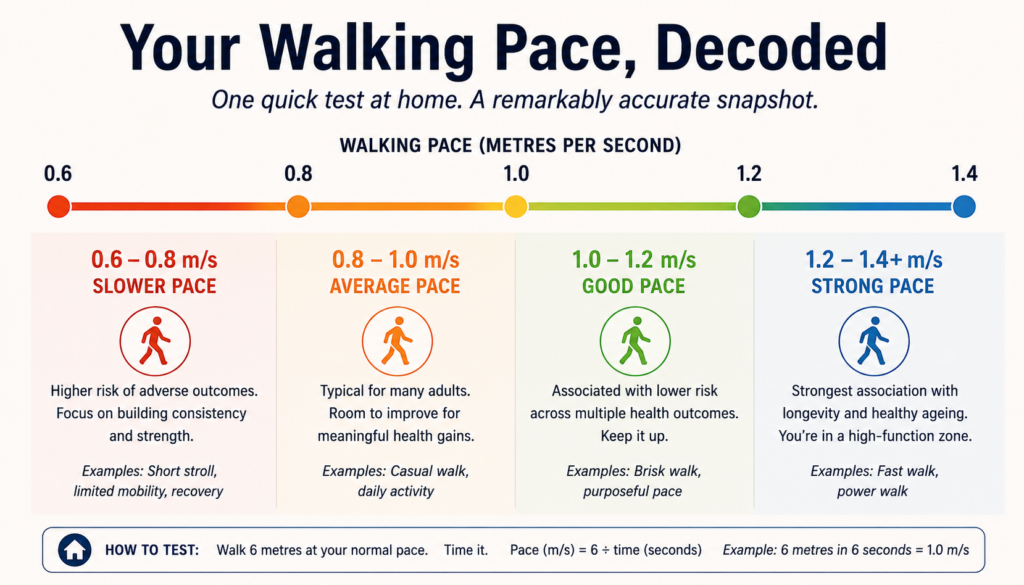
Here’s where it gets specifically useful. The research has identified fairly precise walking speed thresholds that correlate with different life expectancy outcomes. Below are the numbers worth knowing.
| Walking Pace | What It Feels Like | What It Tells You |
|---|---|---|
| Below 0.8 m/s (under 1.8 mph) | Shuffling, cautious, tentative | Significantly elevated mortality risk — worth investigating |
| 0.8–1.0 m/s (1.8–2.2 mph) | Steady but slower than typical | Average life expectancy for age — room to improve |
| 1.0–1.2 m/s (2.2–2.7 mph) | Confident, purposeful, normal | Above-average life expectancy |
| 1.2 m/s and above (over 2.7 mph) | Brisk, energetic, someone with places to be | Significantly extended life expectancy |
To measure your own pace at home, mark out ten metres somewhere flat — a hallway, a garden path, a stretch of pavement. Walk it at your normal, unhurried pace while someone times you. Divide 10 by the number of seconds it took. That’s your metres per second. Do it three times and take the average — walking speed varies more than you’d think from one attempt to the next.
Why Walking Speed Captures So Much
When researchers talk about walking speed as an “integrated biomarker,” this is what they mean. Every step you take is the visible output of dozens of biological systems working together. However, three in particular explain why walking pace maps so tightly onto longevity.
Muscle mass and strength. Walking requires functional strength — particularly in your legs and core. As muscle mass declines with age (a process we’ve explored in depth in our piece on muscle loss after 50), the effort required to walk at a given pace goes up. Your body’s response, often unconsciously, is to slow down. Slower walking is one of the earliest visible signs that sarcopenia is progressing — often long before you notice weakness in daily activities.
Cardiovascular capacity. Brisk walking places a moderate demand on the heart and lungs. If your cardiovascular system is working well, that demand is met effortlessly. If it isn’t, walking faster feels harder, and — again, often unconsciously — you slow down to keep things comfortable. Walking pace is essentially a very gentle, real-world stress test that your body performs every day.
Neurological function. This is the surprising one. Walking, particularly at pace, requires quite sophisticated brain function — balance, coordination, spatial awareness, motor planning. As these systems start to decline, walking speed drops in ways that are measurable years before any cognitive symptoms become obvious. Multiple studies have now linked slow walking speed in midlife with significantly increased risk of dementia decades later. In a large study following more than 1,000 people, researchers found that both slower gait speed and slower processing speed at baseline independently predicted incident all-cause dementia over 12 years of follow-up.
That connection deserves to sit with you for a moment. The pace at which you walk down the street in your 50s and 60s may be telling you something about the pace at which your brain is ageing — and, crucially, giving you a warning early enough to do something about it.
The Good News — This Is a Trainable Number
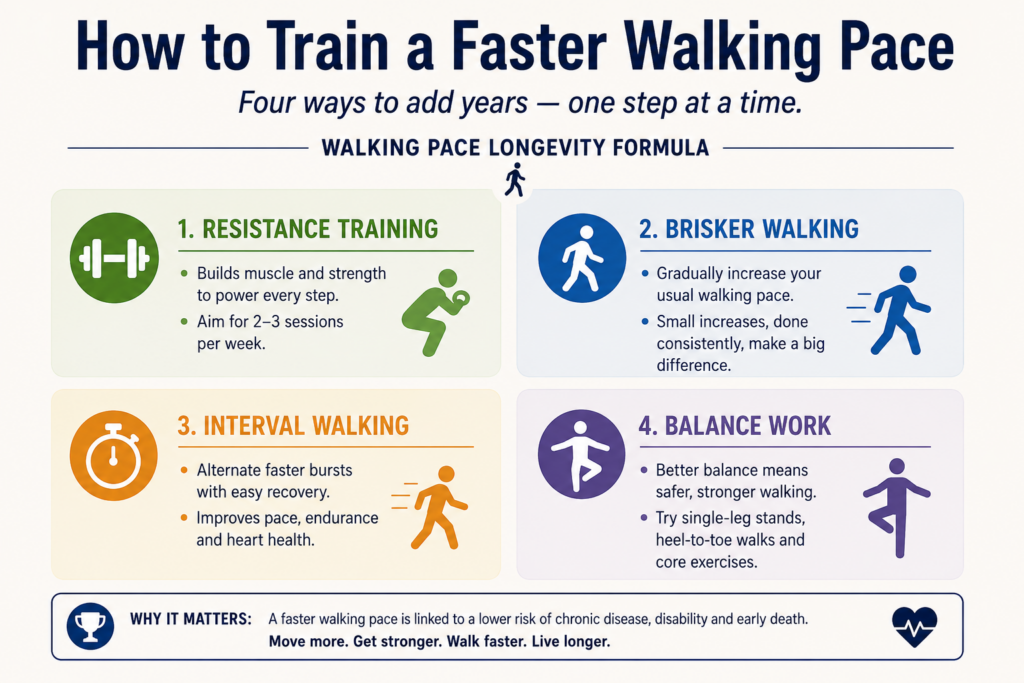
The best thing about walking speed as a longevity marker is that it isn’t fixed. Unlike your family history, your walking pace is something you can genuinely improve — and improving it appears to improve the underlying biology it reflects, not just the number itself. Here’s what actually works.
Resistance training is the single most effective intervention. Building leg strength — through squats, lunges, step-ups, or any exercise that loads the muscles you use to walk — directly translates to a faster, more confident stride. This is especially true after 50, when muscle mass loss is the main cause of pace decline. Our practical guide to strength training after 50 covers exactly how to build this into your week without turning your life into a training programme.
Deliberately brisker walking is genuinely effective. Most people walk at a habitual pace, one that hasn’t changed in years. Simply deciding to walk faster — even 15% faster than usual — for 20-30 minutes several times a week retrains your gait, your cardiovascular capacity, and your neurological patterns. A useful test: aim for a pace where you can hold a conversation but not sing.
Interval walking is a slightly cheeky version of the above. Alternate three minutes of your normal pace with three minutes of significantly brisker walking, repeated for 30 minutes. Japanese researchers have shown that this pattern produces cardiovascular and functional improvements roughly twice as fast as steady-pace walking. It’s also more mentally engaging, which matters more than people admit — you’re more likely to actually do something if it isn’t boring.
Balance and coordination work — even something as simple as regular single-leg standing while brushing your teeth — improves gait quality. Better balance means less unconscious effort spent staying upright, which frees up capacity to walk faster.
All of these fit inside the broader picture of physical activity and healthy ageing — and if you’d like to see how they connect to everything else, our overview of the role of exercise in ageing is a good companion read.
The Underrated Bonus — Walking With Someone Else
Here’s a small point that deserves more attention than it usually gets. A regular walk with a friend or partner doesn’t just improve your fitness — it stacks two independent longevity benefits at once. As we’ve explored in our recent piece on the role of social connections in longevity, regular in-person social contact is itself one of the most powerful longevity interventions we know about. A weekly walking group, a habitual morning walk with a neighbour, a Sunday walk with someone you love — these get counted as “exercise” but they’re really doing two jobs at once.
Sleep quality also plays a bigger role in walking pace than most people realise. Poor sleep affects balance, coordination, and reaction time — all of which show up in a slower, more cautious gait. If you’ve noticed that your walk feels heavier on days after a bad night’s sleep, that’s the same biology being flagged in the research. Our piece on the importance of sleep for longevity covers why this matters more than most people realise.
How This Fits Into the Bigger Picture
The reason walking speed is such a useful marker is precisely because it isn’t isolated. It sits inside the wider work of slowing biological ageing naturally after 50 — where strength, cardiovascular health, neurological function, and lifestyle factors all interact. A single fast walk this week won’t extend your life. However, gradually improving your walking pace over months and years, as part of a broader effort to stay strong and mobile, might do more for your longevity than most of the health interventions being marketed to you.
It also gives you something valuable that most health markers don’t: a real-world, easy-to-track number you can genuinely observe changing. You’ll feel it in the ordinary rhythms of your day. Walking to the shops feels lighter. Stairs feel more manageable. Grandchildren become easier to keep up with. These aren’t clinical outcomes. They are the actual experience of ageing well.
FAQ — Things People Actually Ask
I have a bad knee or hip — does walking pace still apply to me?
The research does show that walking speed matters, but it also matters that the reason for slower walking gets diagnosed properly. Musculoskeletal issues that cause pain are different from age-related decline in muscle mass or cardiovascular fitness. If pain or joint issues are the main brake on your pace, get them properly assessed. Many people find that treating the joint issue — whether through physio, exercise, or medication — brings walking pace back to where it should be for their age.
What about people who use walking sticks or aids?
The research on walking speed generally applies to unaided walking, so if you use aids, the specific numbers are less applicable. However, the underlying principle still holds — walking is a whole-system activity, and maintaining as much strength, balance, and cardiovascular fitness as possible remains valuable at any level of mobility. A physiotherapist can give you personalised advice on what’s realistic and useful in your specific case.
Should I be walking faster all the time now?
No — and trying to would probably make walking feel like a chore. The goal is to gradually raise your default pace over months, not to march everywhere at maximum speed. Three or four sessions a week of deliberately brisker walking, combined with strength training, will slowly lift your habitual pace without you having to think about it. Walking should still feel enjoyable, not performative.
What’s the single most important thing I can do this week?
Measure your walking pace using the ten-metre method above, so you have a baseline. Then add two or three deliberately brisker walks to your week — 20-30 minutes each, at a pace where you can talk but not sing. Combine that with any form of leg strengthening — even sit-to-stand exercises from a kitchen chair — and you’ll be doing more for your walking pace than 90% of people your age.
One Thing to Do This Week
Get out this week and measure your walking pace properly. Ten metres, timed with a phone stopwatch, three attempts, take the average. Write the number down. Then do the same thing in three months’ time. Because here’s the small but powerful truth about walking speed: it’s one of the very few health markers you can meaningfully change through effort, and see the result of that effort with your own eyes. And when you can watch a number move in the right direction, you tend to keep going.
Want to Go Deeper?
If this has made you think differently about how you move through the world — and how much control you have over the trajectory of your ageing — we’ve put together guides covering the practical building blocks of healthy ageing, from strength training to sleep to nutrition.
Browse the full guides library at Slowing the Clock →
Take what’s useful. Leave what isn’t. That’s always the idea.