The Strength Training Sweet Spot for Longevity: New Research

There’s a comforting piece of news for anyone who’s ever felt guilty about not spending enough time in the gym. A landmark study just published in the British Journal of Sports Medicine — tracking nearly 150,000 people for three decades — has finally put a specific number on how much strength training you actually need to live longer. And the number is smaller than most people assume.
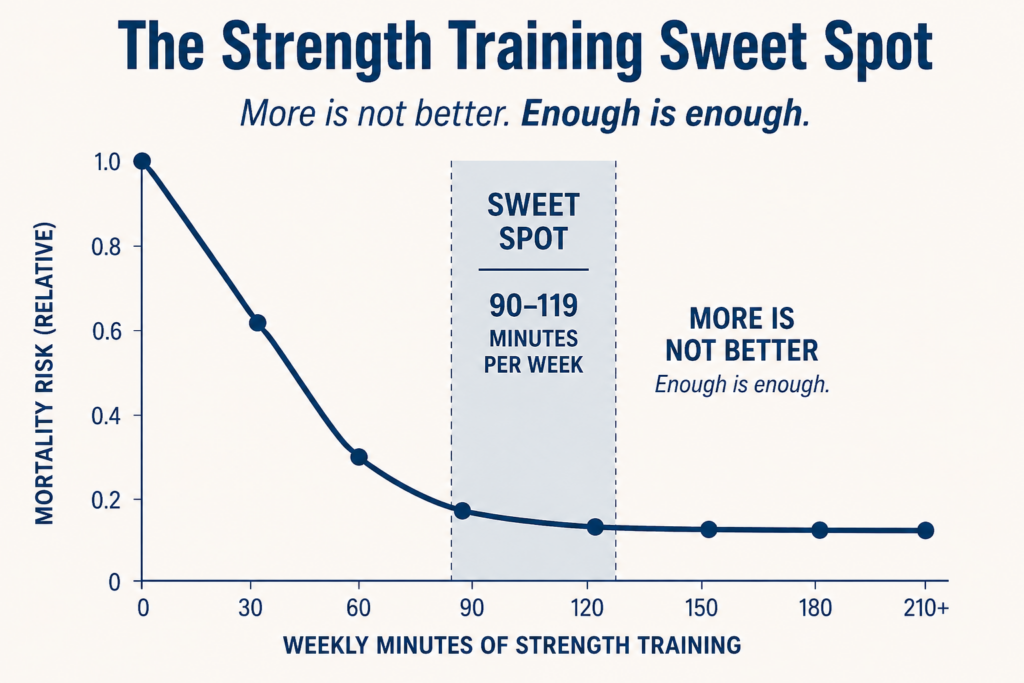
It’s between 90 and 120 minutes a week. That’s it. Two sessions. Under an hour each. Do more than that and, based on this study at least, you get no additional survival benefit. Do less and you’re still doing something valuable — but the sweet spot is remarkably specific, remarkably modest, and remarkably reachable for almost anyone reading this.
However, buried inside the same study is a finding almost nobody is talking about — and it’s arguably the most important of the lot.
⚡ What You’ll Learn in the Next 5 Minutes
- The exact weekly minutes of strength training that produce the biggest longevity benefit
- The striking brain-protection finding that’s being underreported everywhere
- Why doing more than the sweet spot doesn’t help — and might waste your time
- What happens when you combine strength training with aerobic exercise
- A practical two-session-a-week template you can start this week
The Study — And What Makes It Different
Most exercise research suffers from one of two problems. Either it follows a small number of people for a short time, or it relies on self-report from populations that don’t represent the general public. However, the study we’re talking about here — published in June 2026 by researchers led by Yiwen Zhang at the Harvard T.H. Chan School of Public Health — is genuinely different.
The team analysed three decades of data from three of the largest and best-designed health cohort studies in the world: the Health Professionals Follow-up Study, the Nurses’ Health Study, and the Nurses’ Health Study II. Combined, they tracked 147,374 participants — 31,540 men and 115,834 women — with an average starting age of 54. Every two years, participants reported how much strength training and aerobic exercise they were doing. Over the 30-year follow-up, 35,798 of them died. The researchers then looked at what patterns emerged in the survivors.
Because here’s the thing. When you have this much data over this long a period, you can start to see not just whether exercise helps, but exactly how much helps most. And what the numbers said was surprisingly precise.
The Sweet Spot — 90 to 120 Minutes
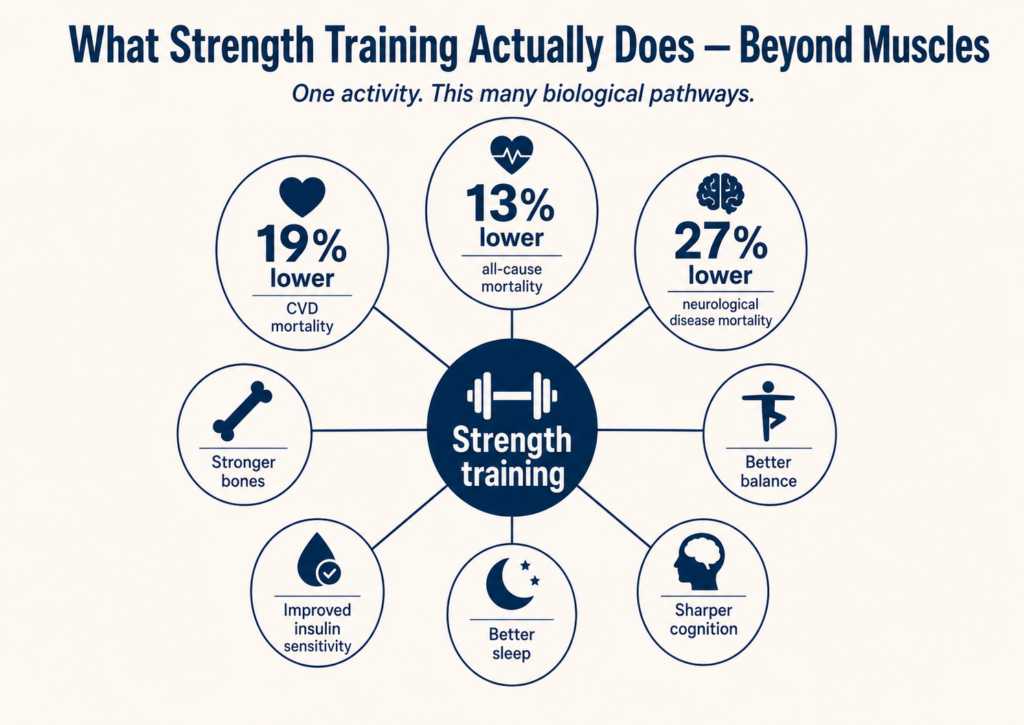
After controlling for age, diet, smoking, aerobic exercise, and dozens of other variables, participants who did between 90 and 119 minutes of strength training per week had a 13% lower risk of death from any cause over the follow-up period compared with those who did none. That’s a substantial reduction — and it came from what amounts to two sessions of 45 minutes or three sessions of 30 minutes per week.
However, the more interesting finding is what happened above that threshold. Participants doing more than 120 minutes of strength training per week showed no additional mortality benefit. The curve flattened. More effort, more time, more sets — no extra years. This aligns with a growing body of research suggesting that when it comes to strength training and longevity, consistency at a moderate volume beats heroic weekly totals.
That’s genuinely liberating news. If you’ve been avoiding strength training because you assumed it required an all-consuming commitment, this study is telling you the opposite. Under an hour, twice a week, is where the biggest longevity return sits. If you already do that — you’re doing enough.
The Brain Protection Finding Nobody’s Talking About
Buried in the same study is a result that arguably deserves more attention than the headline mortality number. In the same 90-119 minute window, participants had a 27% lower risk of death from neurological disease — a category that includes Alzheimer’s, Parkinson’s, and other conditions of the ageing brain.
Let that sit for a moment. Twenty-seven percent. From two sessions a week of resistance training.
This isn’t the finding most exercise coverage focuses on. Most people, when they talk about strength training and health, talk about muscles, bones, metabolism, and the heart. The brain rarely enters the conversation. However, the emerging science on why resistance training protects the brain is genuinely fascinating. Working muscles release signalling molecules called myokines that cross the blood-brain barrier and appear to promote the growth and survival of neurons. Regular resistance training improves cerebral blood flow. It reduces the chronic inflammation that drives neurodegeneration. It improves insulin sensitivity — and increasingly, researchers are describing Alzheimer’s disease as, at least in part, a form of brain insulin resistance.
None of this is a promise. Observational data cannot prove that strength training directly prevents dementia. However, this study joins a growing body of evidence pointing in the same direction — and the effect size here is genuinely striking. If you were told a supplement could reduce your neurological death risk by 27%, it would be a headline for weeks. That two sessions of resistance training might do the same thing barely made a ripple.
What Happens When You Combine Cardio and Strength
Here’s where the study gets even more useful. The researchers didn’t just look at strength training in isolation. They looked at what happens when you combine it with aerobic exercise — and the results are worth understanding, because they change how you might structure your week.
Participants who did high levels of aerobic exercise and 60-119 minutes of weekly strength training had a 45% lower risk of death. Push the aerobic exercise even higher and the risk reduction climbed to somewhere between 53% and 58%. In other words, aerobic and strength training don’t just add together — they compound. They work through different biological pathways, and stacking them produces protection that neither achieves alone.
The practical implication is simple. If you’ve been treating your weekly workout as a choice between cardio and weights, the data suggests you should stop. Both. Not as a performance goal, but as a longevity strategy.
What the Ideal Week Actually Looks Like
Based on this study and the wider evidence, a week that clears both thresholds looks something like this:
| Day | Type | Duration | What It Looks Like |
|---|---|---|---|
| Monday | Strength training | 45 minutes | Full body — squats, rows, presses, hinges |
| Tuesday | Aerobic (moderate) | 45 minutes | Brisk walking, cycling, swimming |
| Wednesday | Rest or gentle movement | — | Walk, mobility, yoga |
| Thursday | Strength training | 45 minutes | Full body — same compound patterns |
| Friday | Aerobic (moderate) | 45 minutes | Longer walk, run, or cycle |
| Weekend | Active recreation | 1–2 hours | Hiking, gardening, tennis, family activity |
Two 45-minute strength sessions gets you to 90 minutes — right inside the sweet spot. Add roughly 90 minutes of moderate aerobic exercise across the week and you clear the cardiovascular threshold too. Nothing here requires a gym membership, a personal trainer, or a wardrobe of Lycra. If you’d like a practical starting point specifically designed for the over-50s, our guide to strength training after 50 walks through exactly how to build this without injury or overwhelm.
Why This Matters More After 50
The findings from this study are important for everyone. However, they matter disproportionately more after 50 — and it’s worth being clear about why.
From your mid-30s onwards, you’re losing muscle mass. That loss accelerates significantly after 50, and by 60 many people have lost 15-20% of the muscle they had in their prime. This condition — sarcopenia — quietly drives many of the outcomes we associate with “old age”: slower metabolism, weakened bones, poor balance, increased fall risk, and the loss of independence that so often follows a serious fall. We’ve written extensively about this in our piece on muscle loss after 50, but the short version is: without a specific intervention, this is happening to you right now.
Resistance training is that intervention. Nothing else replaces it — not walking, not swimming, not yoga. All of those have benefits, but none of them meaningfully rebuild the muscle mass you’re losing. And what this new study adds is a genuinely useful specificity: not “do some resistance training” but “do 90 to 120 minutes per week.” A target you can actually plan around.
The broader context of what strength training does for longevity — and why it deserves to be at the centre of any healthy ageing plan — is something we cover in our deeper dive on strength training and longevity. This new research doesn’t overturn any of that. It sharpens it.
The Limits of the Study — And What It Doesn’t Tell You
Any piece of research worth reporting is also worth putting in context, and this one has honest limitations. It’s observational, which means it cannot prove that strength training directly caused the reductions in death risk — it can only show a strong association. Exercise habits were self-reported, which introduces the usual inaccuracies. The study didn’t include certain forms of resistance training like calisthenics or Pilates. And it didn’t measure the intensity of the sessions people were doing.
However, none of that undermines the core finding. When a study of this size, over this length of time, with this level of statistical control, produces effect sizes this large — you don’t need randomised controlled trial data to take it seriously. You act on the balance of evidence. And on strength training, that balance is now decisively in favour of two moderate sessions a week as one of the best longevity investments any of us can make.
Alongside strength training, the other big longevity levers — sleep, nutrition, and social connection — deserve equal weight. If you want to see how they all fit together, our overview of how to slow biological ageing naturally after 50 pulls the whole picture together.
FAQ — Things People Actually Ask
What actually counts as “strength training” in this context?
Any activity where your muscles are working against meaningful resistance — enough that the last few repetitions feel genuinely challenging. That includes weights, resistance bands, weight machines, and bodyweight exercises like press-ups, squats, and lunges done to a level that fatigues you. Gentle exercises with no progression don’t count. What matters is that the effort is real.
Can I split the 90 minutes across more than two sessions?
Yes — and for some people this works better than trying to squeeze it into two sessions. Three sessions of 30 minutes, or even four sessions of 25 minutes, will produce very similar results provided the total weekly volume adds up. What the research is clear about is that spreading strength work across the week is better than cramming it into a single mammoth session.
I’m in my 60s and have never lifted weights. Is it safe to start?
Almost certainly, yes — and the benefits at your age are actually larger, not smaller. Start with bodyweight exercises or very light resistance, focus on learning the movement patterns correctly, and progress gradually. If you have any specific health concerns — particularly cardiovascular issues or joint problems — check in with your GP or a physio before starting. However, “I’m too old for this” is one of the least accurate reasons for avoiding resistance training you’ll ever encounter.
What’s the single most important thing I can do this week?
Put two 45-minute strength training sessions in your diary this week — actual calendar entries, at specific times. That single act is the difference between people who intend to train and people who train. It doesn’t matter yet whether the sessions are at home, at the gym, or in the local park with a set of resistance bands. What matters is that they exist as commitments, not intentions.
One Thing to Do This Week
Open your calendar right now and block out two 45-minute strength training slots for the next seven days. Not vague intentions. Actual times, on actual days, that you’re committing to. If you’re new to this, the first session can be as simple as bodyweight squats, press-ups against a wall, glute bridges, and rows using a resistance band. What the research is telling us is that these sessions matter enormously for how long — and how well — you live. Two 45-minute slots. That’s the whole ask.
Want to Go Deeper?
If you’d like a proper structured plan — one specifically designed for people in their 50s and 60s who want to build strength without injury or overwhelm — we’ve put together guides that walk through exactly what to do, how often, and how to progress.
Browse the full guides library at Slowing the Clock →
Take what’s useful. Leave what isn’t. That’s always the idea.