You’re Losing Muscle Right Now. Here’s Why That Matters More Than Your Weight.

Nobody tells you about this one. You eat reasonably well, you’re not completely sedentary, your weight hasn’t changed much in years — and yet something is quietly shifting inside your body that will affect everything from how long you live to whether you can carry your own shopping bags at 75.
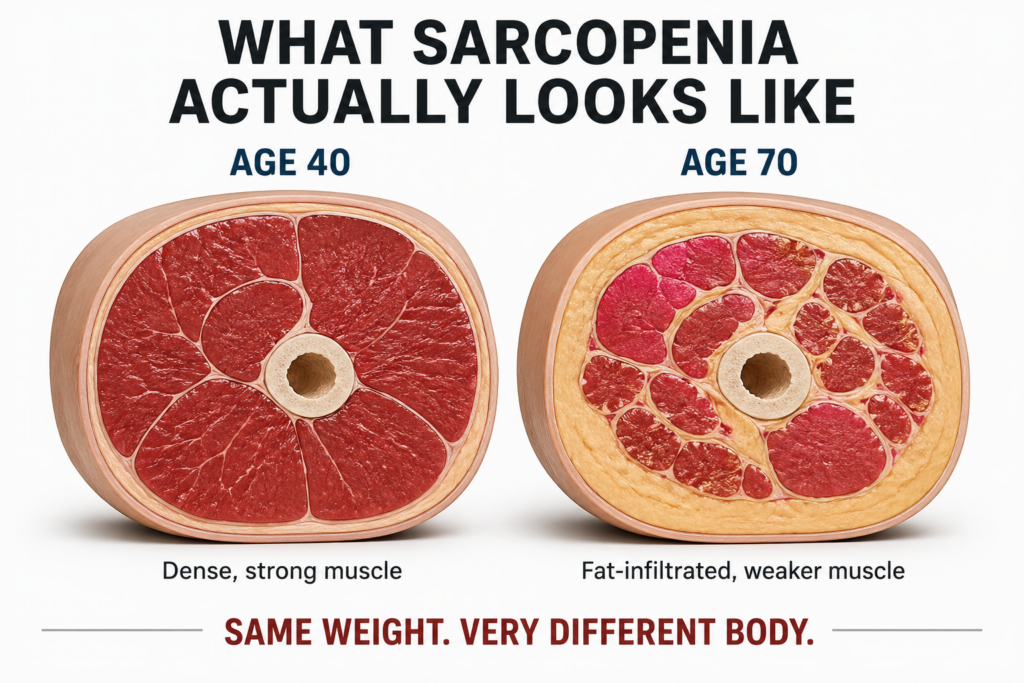
It’s called sarcopenia — the gradual loss of muscle mass that begins in your 30s and accelerates sharply after 50. By the time most people notice it, they’ve already lost a significant amount. And here’s the thing: the number on the scale won’t tell you. Your clothes might still fit. But inside, the balance is shifting — less muscle, more fat — and that shift has consequences that go far beyond how you look.
The good news? It is almost entirely reversible. But you have to know what you’re dealing with first.
⚡ What You’ll Learn in the Next 5 Minutes
- Why muscle loss — not weight gain — is the real ageing threat after 50
- The surprising speed at which it happens (and what accelerates it)
- The simple protein rule most people over 50 are getting completely wrong
- Why the type of exercise matters more than the amount
- The one number worth tracking that most people never check
So What Exactly Is Sarcopenia — and Why Has Nobody Mentioned It?
Good question. The word comes from the Greek for “poverty of flesh” — which sounds grim, but it’s accurate. From around age 35, we lose roughly 3–8% of our muscle mass per decade. After 60, that rate can double.
To put that in real terms: if you’re 60 and haven’t done anything specific to counter this, you may have lost 15–20% of the muscle you had in your prime. That’s not just an aesthetic issue. Muscle is metabolically active tissue — it burns calories at rest, regulates blood sugar, supports your joints, and plays a direct role in immune function.
Less muscle means a slower metabolism, higher insulin resistance, weaker bones, poorer balance, and a significantly increased risk of falls — which, in older adults, is one of the leading causes of serious injury and loss of independence. Research published in PubMed has linked low muscle mass to increased all-cause mortality. This isn’t a vanity issue. It’s a longevity issue.
And yet somehow, it barely gets mentioned. We obsess over BMI, cholesterol, blood pressure. But almost nobody measures muscle mass.
Why Does It Happen Faster After 50?
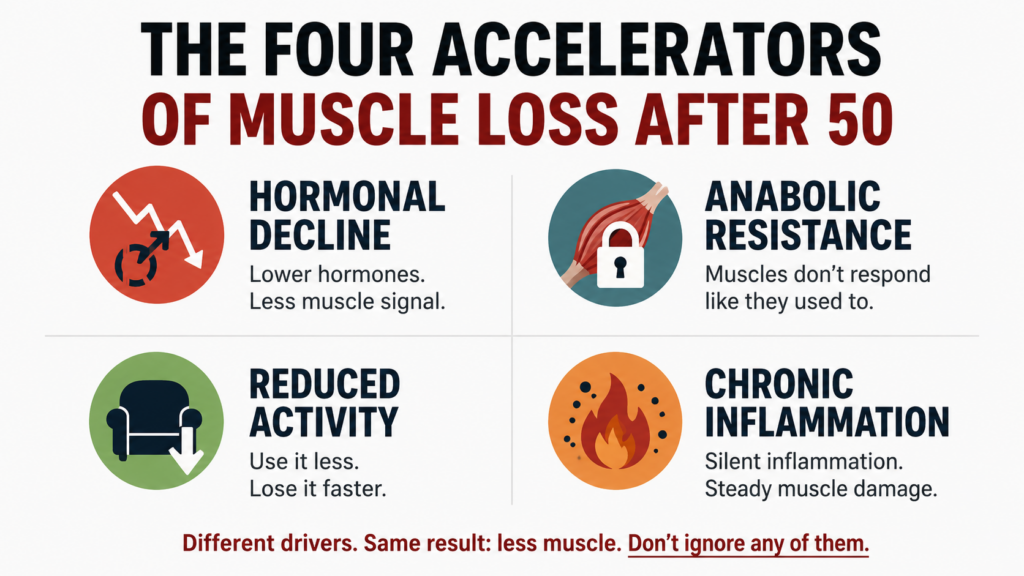
Several things converge at once, and not in a helpful way.
Hormones shift. Testosterone and oestrogen — both of which support muscle retention — decline significantly in your 50s. So does growth hormone. The anabolic (muscle-building) signals that kept things ticking over quietly in your 30s start to fade.
Protein synthesis slows. Older muscles become less efficient at using the protein you eat to build and repair tissue — a phenomenon researchers call “anabolic resistance.” You need more protein, not less, as you age. Most people do the opposite.
Activity levels drop. Often subtly. You’re not necessarily doing nothing — but the daily incidental movement of an active job, chasing kids, carrying things — that all tends to reduce. And muscle, frustratingly, responds to disuse with remarkable speed. Two weeks of reduced activity can cause measurable muscle loss.
Chronic inflammation creeps up. Low-grade, systemic inflammation — sometimes called “inflammaging” — actively degrades muscle tissue over time. Poor sleep, high stress, processed food, and a sedentary lifestyle all feed it. You can read more about the inflammation connection in our piece on the role of exercise in ageing.
The Protein Problem: You’re Probably Not Eating Enough
This one surprises almost everyone. The standard recommended daily allowance for protein — 0.8g per kilogram of bodyweight — was set as a minimum to prevent deficiency, not as a target for healthy ageing. For people over 50, most sports scientists and longevity researchers now recommend somewhere between 1.6g and 2.2g per kilogram of bodyweight per day.
For a 75kg person, that’s roughly 120–165g of protein daily. Most people eating a typical Western diet are getting about half that.
The other thing that matters is distribution. Your muscles can only use so much protein at once — roughly 30–40g per meal for effective muscle protein synthesis. Eating 20g at breakfast, 15g at lunch, and 80g at dinner (which is basically what most people do) is not the same as spreading it evenly. Front-load your day.
Good sources: eggs, Greek yoghurt, chicken, fish, legumes, cottage cheese, tofu. And yes — quality protein supplements can be useful here, especially if appetite decreases with age, which it often does. Our deep-dive on protein and ageing covers this in a lot more detail if you want the full picture.
One more thing worth noting: if you’re experimenting with intermittent fasting, be aware that compressing your eating window can make it significantly harder to hit adequate protein targets. It’s not impossible, but it requires deliberate planning — something most IF guides conveniently skip over.
The Exercise Truth Nobody Wants to Hear
Walking is wonderful. Swimming is great. Yoga has real benefits. But none of them will meaningfully reverse sarcopenia. The only type of exercise proven to rebuild lost muscle mass is resistance training — lifting weights, using resistance bands, or doing bodyweight exercises that genuinely challenge your muscles.
The good news is you don’t need to become a gym obsessive. Studies consistently show that two to three sessions per week, each lasting 30–45 minutes, is enough to produce meaningful results — even in people in their 70s and 80s. Your muscles don’t know how old you are. They respond to stimulus.
The key principles:
- Progressive overload — gradually increasing the challenge over time. If it stops feeling hard, it stops working.
- Compound movements — exercises that work multiple muscle groups at once (squats, deadlifts, rows, presses) give you more return for your time.
- Consistency over intensity — showing up regularly matters far more than any single heroic session.
If you’re not sure where to start, our guide to strength training after 50 is genuinely one of the most practical things we’ve published. No gym required for a lot of it.
The Comparison You Actually Need to See
People spend a lot of time worrying about cardio versus weights. Here’s a cleaner way to think about it when muscle preservation is the goal:
| Exercise Type | Builds Muscle Mass | Burns Calories | Supports Bone Density | Improves Balance |
|---|---|---|---|---|
| Resistance Training | ✅ Yes — directly | ✅ Yes + afterburn | ✅ Strong evidence | ✅ Yes |
| Cardio (walking, cycling) | ⚠️ Minimal | ✅ Yes — during | ⚠️ Some (weight-bearing) | ⚠️ Limited |
| Yoga / Pilates | ⚠️ Limited | ⚠️ Modest | ⚠️ Limited | ✅ Yes — strong |
| HIIT | ✅ Some (if resistance-based) | ✅ Yes + afterburn | ✅ Yes | ⚠️ Depends on type |
The ideal? Resistance training as your foundation, cardio as your complement. Not the other way around. Most people in their 50s have it backwards.
What About Supplements?
A few are worth knowing about. Creatine monohydrate has some of the strongest evidence for supporting muscle retention and strength in older adults — and it’s cheap, safe, and well-studied. Vitamin D deficiency is extremely common after 50 and directly affects muscle function. Worth checking your levels.
Beyond those two, the supplement landscape gets murkier. We’ve done a thorough look at what the research actually says about multivitamins and longevity — the results might surprise you.
The broader picture of healthy ageing — of which muscle is just one piece — is covered well in our article on how to slow biological ageing naturally after 50. Worth a read if you want the full framework, not just the muscle piece.
FAQ — Things People Actually Ask
Can I really build muscle after 60?
Yes — unambiguously. Research consistently shows that adults in their 60s, 70s, and even 80s respond to resistance training with measurable gains in muscle mass and strength. The process is slower than it was at 30, and protein intake needs to be higher, but the biology still works. The key is starting — and being consistent.
How do I know if I’m losing muscle?
The scale won’t tell you, because muscle loss is often offset by fat gain — your weight stays the same while your body composition worsens. Better indicators: grip strength (a surprisingly reliable predictor of overall muscle health), how easily you rise from a chair without using your arms, and your walking pace. A DEXA scan gives you precise data if you want to know exactly where you stand.
Is it possible to do too much protein?
For most healthy adults, the evidence suggests protein intakes up to 2.2g per kg of bodyweight are safe and beneficial. Concerns about kidney damage from high protein are largely relevant only to people with pre-existing kidney disease. If in doubt, speak with your GP — but most people over 50 are dramatically under-eating protein, not over-eating it.
What’s the single most important thing I can do this week?
Start resistance training — even just two sessions. Bodyweight squats, press-ups, and rows can be done at home with no equipment. And track your protein for three days. Most people are shocked by how far short they fall.
One Thing to Do This Week
Track your protein intake for three days. Just three. Use any free app — Cronometer, MyFitnessPal, whatever you prefer. Aim for at least 1.6g per kilogram of your bodyweight daily and see how close you get. For most people, this single exercise is eye-opening enough to change how they eat permanently.
Want to Go Deeper?
We’ve put together a collection of guides — some free, some paid, some bundled — covering everything from strength training protocols to nutrition plans built specifically for healthy ageing. If any of this has resonated, it’s a good place to start.
Browse the full guides library at Slowing the Clock →
No pressure. Take what’s useful, leave what isn’t. That’s always the idea.