Stop Overcomplicating Things. These 3 Habits Add Years to Your Life.

Somewhere between the cold plunge pools, the continuous glucose monitors, and the £80-a-month supplement stacks, something got lost. The message that living longer and feeling better as you age is — for most people — not complicated. It doesn’t require biohacking. It doesn’t require a personal trainer, a nutritionist, or a walk-in freezer.
It requires doing three things consistently. That’s it. And the research behind each of them is so solid, so replicated, so utterly unsexy that the wellness industry largely ignores it in favour of things that are easier to sell.
Here’s what actually moves the needle.
⚡ What You’ll Learn in the Next 5 Minutes
- The single most evidence-backed form of exercise for living longer — and it’s not what most people are doing
- Why sleep is ageing you faster than almost anything else (and the fix isn’t “8 hours”)
- The longevity factor that nobody talks about — and why ignoring it is as dangerous as smoking
- How to start all three this week without overhauling your life
- The one surprising truth that ties all three together
Habit 1: Lift Something Heavy. Twice a Week. That’s All.
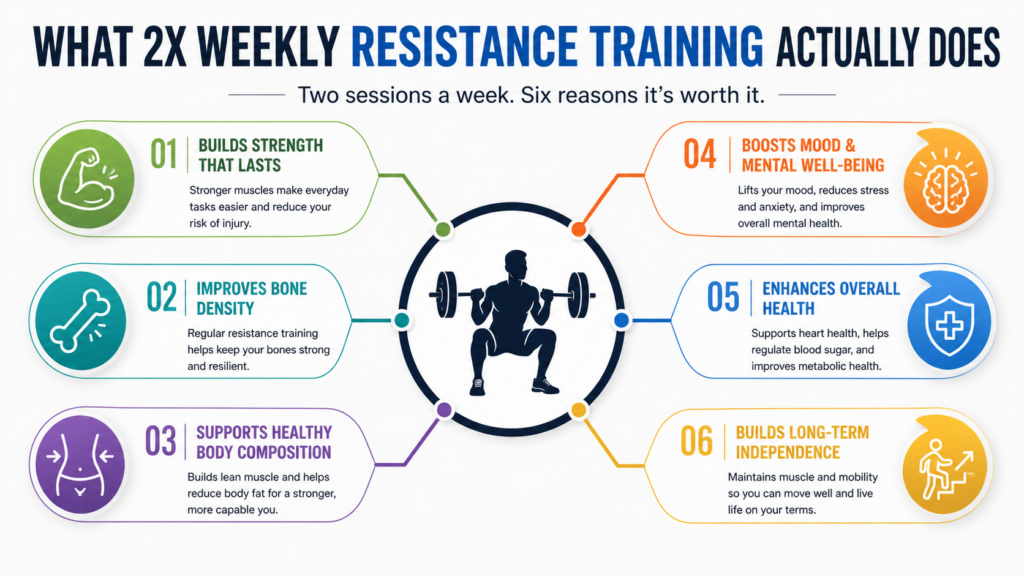
If you do one thing after reading this, make it this one. Resistance training — lifting weights, using resistance bands, or doing challenging bodyweight exercises — is the single most underused longevity tool available to anyone over 50. And almost nobody is doing it.
Here’s why it matters so much. From your mid-30s onwards, you’re losing muscle mass — quietly, invisibly, without the scales necessarily moving. By 60, many people have lost 15–20% of the muscle they had in their prime. That loss doesn’t just affect how you look. It slows your metabolism, weakens your bones, raises your insulin resistance, and dramatically increases your risk of falls — one of the leading causes of serious injury and loss of independence in later life.
The good news is your muscles don’t know how old you are. They respond to stimulus at 60, 70, even 80. Studies consistently show that two sessions per week of resistance training is enough to produce meaningful improvements in muscle mass, strength, and metabolic health — even in complete beginners.
You don’t need a gym. You don’t need equipment. You need to make your muscles work harder than they’re used to, progressively, over time. Our guide to strength training and longevity covers exactly how to build this into your week without it taking over your life.
Habit 2: Fix Your Sleep — But Not the Way You Think
You already know sleep is important. Everyone does. Which is why telling you to “get more sleep” would be a waste of your time.
Here’s what’s actually worth knowing. It’s not just the quantity of your sleep that matters — it’s the quality. Specifically, the depth. During deep, slow-wave sleep, your brain clears out metabolic waste products — including the amyloid plaques associated with Alzheimer’s disease. Your cells repair. Your immune system consolidates. Your stress hormones reset.
Poor sleep quality — even if you’re clocking 7 or 8 hours — accelerates biological ageing measurably. Research has linked chronic sleep disruption to shorter telomeres (the protective caps on your DNA that shorten as you age), higher levels of systemic inflammation, and significantly increased risk of cardiovascular disease, type 2 diabetes, and cognitive decline.
The culprits most people overlook: alcohol (it fragments deep sleep even in small amounts), late-night screen exposure, and eating too close to bedtime. Fix those three before you buy a single sleep supplement.
If you want to understand what’s really happening when you sleep badly — and what to do about it — our deep dive into the importance of sleep for longevity is one of the most thorough things we’ve written.
| Sleep Killer | What It Actually Does | The Fix |
|---|---|---|
| Alcohol | Fragments deep sleep, even 1–2 drinks | Stop drinking 3+ hours before bed |
| Screens before bed | Suppresses melatonin, delays sleep onset | No screens 60 mins before sleep |
| Late eating | Raises core temperature, disrupts sleep cycles | Finish eating 2–3 hours before bed |
| Irregular sleep times | Disrupts circadian rhythm, reduces sleep quality | Same bedtime and wake time — even weekends |
| Stress / racing mind | Keeps cortisol elevated, prevents deep sleep | 10-min wind-down routine — no exceptions |
Habit 3: The One Nobody Takes Seriously Enough
Here’s the counterintuitive one. The longevity habit that gets the least airtime, attracts zero investment from the wellness industry, and can’t be bottled, packaged, or sold.
Human connection.
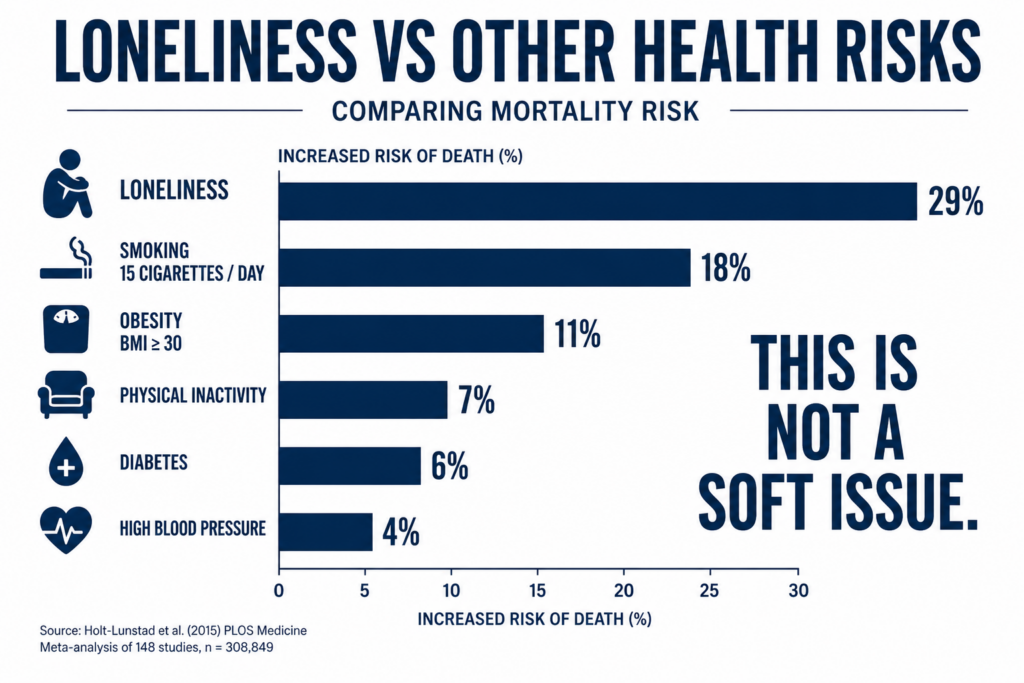
A landmark analysis of 148 studies — covering over 300,000 people — found that strong social relationships increased the odds of survival by 50%. To put that in context: the mortality risk of loneliness and social isolation is comparable to smoking 15 cigarettes a day. It exceeds the risk of obesity. It exceeds physical inactivity.
This isn’t soft science. This isn’t feel-good wellness advice. This is hard data, replicated across decades of research, and it barely registers in mainstream health conversations because there’s nothing to sell alongside it.
What counts as “connection” is broader than most people think. It’s not just close friendships or romantic relationships — though those matter enormously. It’s regular contact with people who know your name. A regular exercise class. A neighbour you actually talk to. A hobby group. Volunteering. Anything that creates genuine, repeated human contact.
There’s also a related factor worth mentioning: purpose. People with a strong sense of why they get up in the morning live measurably longer. The two are deeply linked — connection gives us purpose, and purpose drives us toward connection. Our piece on finding and living your purpose explores this in a way that might reframe how you think about the second half of life.
For the full picture on what the research actually shows about relationships and lifespan, our article on the role of social connections in longevity is essential reading — particularly if you live alone or have noticed your social world shrinking since retirement or the pandemic.
The Thing That Ties All Three Together
Look at these three habits and you’ll notice something. None of them are quick fixes. None of them work in isolation. And none of them require anything you don’t already have access to.
What they share is this: consistency over time. Two strength sessions a week, done for a year, will transform your body composition more profoundly than any supplement. Eight months of better sleep will measurably reduce your biological age. A year of deliberate social connection will do more for your longevity than almost any clinical intervention.
The wellness industry survives on complexity. On making you feel like you’re always one product away from optimal health. The research tells a different story — that the fundamentals, done consistently, beat almost everything else on the market.
You already knew that, somewhere. This is just the reminder.
FAQ — Things People Actually Ask
Do I really need to lift weights or will walking do it?
Walking is genuinely good for you — for cardiovascular health, mental health, and maintaining a healthy weight. But it won’t meaningfully preserve muscle mass as you age. For that, you need resistance training specifically. The good news is that two sessions a week is enough, and you can start with bodyweight exercises at home.
I sleep 8 hours but still wake up tired — what’s going on?
Duration and quality are not the same thing. You can spend 8 hours in bed and still get very little deep, restorative sleep — particularly if you drink alcohol, use screens late, or have an inconsistent sleep schedule. Tracking your sleep with a basic wearable can be eye-opening. Start by eliminating the four main sleep killers in the table above.
I’m not naturally sociable — does this still apply to me?
Yes — and the research doesn’t require you to be an extrovert. What matters is regular, genuine human contact, not the quantity or intensity of your social life. Even introverts benefit enormously from a small number of consistent connections. The key word is regular — sporadic contact doesn’t carry the same protective effect.
What’s the single most important thing I can do this week?
Start resistance training. Book two sessions into your diary right now — even if it’s just 30 minutes of bodyweight exercises at home. Of the three habits here, it’s the one with the fastest visible return and the one most people are not doing at all. Sleep and connection improvements take longer to feel. This one you’ll notice within weeks.
One Thing to Do This Week
Pick the one habit from this list that you’re most neglecting right now — just one — and commit to one small action today. Not a plan. Not a resolution. One action. Book a class, go to bed 30 minutes earlier tonight, call someone you haven’t spoken to in a while. The research is clear on this too: starting small and staying consistent beats ambitious plans that collapse after a fortnight every single time.
Ready to Go Deeper?
We’ve put together guides on all three of these areas — some free, some paid — with practical frameworks you can actually follow rather than just read and forget.
Browse everything at the Slowing the Clock guides library →
Take what’s useful. Leave what isn’t. That’s always the idea.