How Your Hormones Are Rewriting Your Sleep After 50 — And What Actually Helps

You used to sleep like a stone. Head on the pillow, and next thing you knew it was morning. Somewhere in your late 40s or early 50s, that changed — quietly, gradually, without any obvious explanation. You started waking at three in the morning for no reason. You’d fall asleep easily enough and then find yourself, wide awake, ninety minutes later. Perhaps the room felt too hot, or you were suddenly drenched in sweat. Perhaps you simply couldn’t shut your brain up.
What almost nobody explains, in the frustrating GP appointments and the well-meaning wellness articles, is that this isn’t really a sleep problem. It’s a hormonal problem — one that’s rewriting the biology of your nights in ways that no amount of chamomile tea will fully fix. However, understanding what’s actually happening is the first step to doing something useful about it.
⚡ What You’ll Learn in the Next 5 Minutes
- Why sleep changes so dramatically after 50 — and why it’s not “just ageing”
- The specific hormones behind midnight waking, night sweats, and racing thoughts
- How the sleep-hormone relationship becomes a vicious cycle (and why it matters)
- What the evidence actually says about HRT and sleep quality
- Practical, non-medical interventions that genuinely help
The Hormones That Run Your Sleep — And What’s Changing
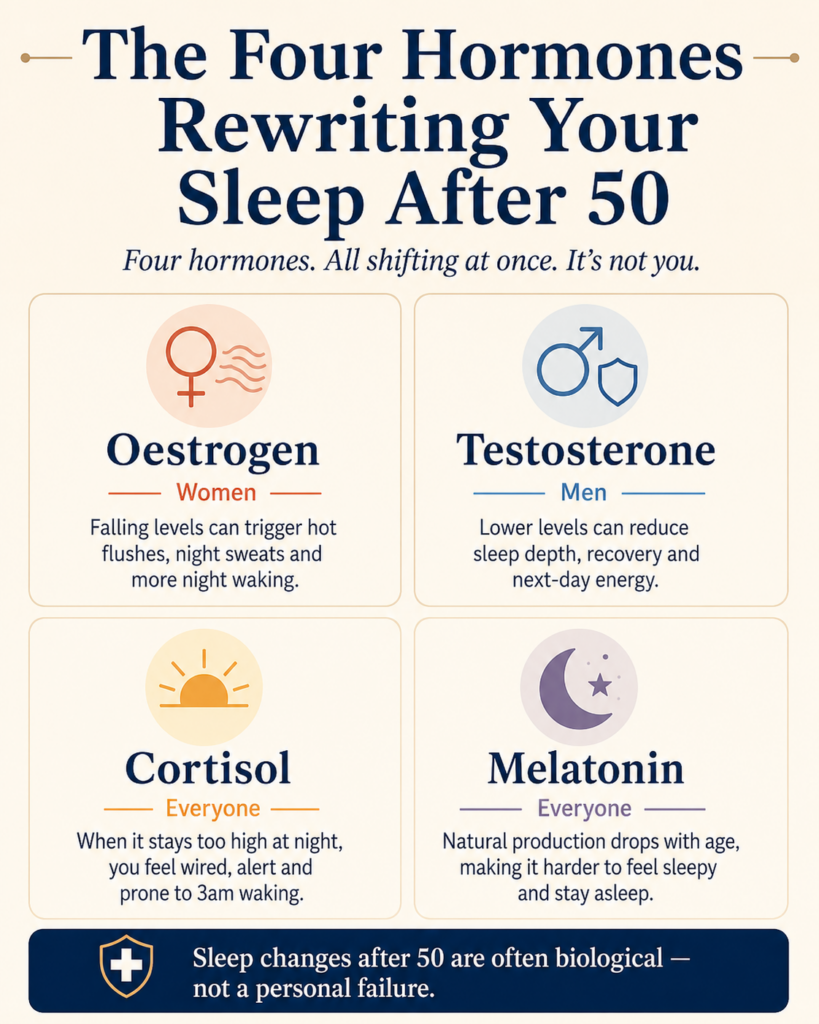
Before 50, sleep is largely something that happens to you. After 50, sleep becomes something you increasingly have to work at — and the reason is that four hormones critical to sleep quality all start behaving differently around the same time.
Oestrogen and progesterone. In women, these two hormones don’t just regulate reproductive function — they profoundly affect sleep architecture. Oestrogen supports deep sleep and REM sleep. Progesterone has a genuinely calming, sedative effect on the brain. As both decline through perimenopause and drop further after menopause, the sleep patterns they were quietly supporting begin to unravel. Research suggests around 40-60% of menopausal women report significant sleep disturbance, and perimenopause affects up to 80-90% of women in some form.
Testosterone. Levels decline in men from roughly age 30, at a rate of about 1% per year — which sounds trivial but adds up significantly by the time you’re 55 or 60. Lower testosterone is linked to fragmented sleep, reduced deep sleep, and — critically — to a vicious cycle where poor sleep further reduces testosterone. It’s not just women whose hormones affect their nights.
Cortisol. The stress hormone that follows a natural daily rhythm — high in the morning to help you wake, low at night to allow sleep. After 50, this rhythm becomes less well-regulated for many people. Cortisol can spike in the small hours, waking you at 2 or 3am and making it very hard to get back to sleep. Chronic stress accelerates this pattern. So does poor sleep itself, creating a self-reinforcing loop.
Melatonin. The sleep hormone your brain produces in response to darkness. Melatonin production peaks in your teens and declines significantly with age — by 60, most people produce less than half the melatonin they did at 20. The signals telling your brain it’s time to sleep are, quite literally, getting weaker.
What makes this particularly frustrating is that most people experience these changes as a personal failure. They wonder what’s wrong with them. What’s wrong is nothing — it’s ordinary human biology behaving exactly as it’s designed to. Understanding the mechanism is the beginning of reclaiming some agency over it. As we’ve explored in our piece on how poor sleep accelerates ageing, none of this is trivial — sleep sits at the centre of healthy ageing.
Why Women and Men Experience This Differently
The hormonal drama of the menopause transition is well-documented — even if not always well-treated. Vasomotor symptoms (hot flashes and night sweats) affect roughly three-quarters of women during perimenopause and menopause, and they are one of the most direct causes of fragmented sleep. However, sleep disturbance in menopausal women is more than just hot flashes. The underlying loss of progesterone’s sedative effect and oestrogen’s regulation of sleep architecture continues to affect sleep quality even in women who don’t experience obvious night sweats. This is why treating only the visible symptoms often leaves the underlying sleep problem partly intact.
For men, the picture is less dramatic but no less real. Testosterone decline is gradual rather than abrupt, and the sleep effects are consequently more subtle — a slow fragmentation of sleep quality, more waking during the night, less refreshing sleep. Men over 50 also have significantly higher rates of obstructive sleep apnoea, which further disrupts sleep architecture and further reduces testosterone. A large body of research now confirms that sleep loss reduces testosterone the following day, and lower testosterone worsens sleep the night after. It’s a two-way biological loop.
Both sexes, additionally, experience the age-related decline in melatonin and the disrupted cortisol rhythm — which is why sleep problems after 50 aren’t purely a “menopause” issue. Men and women are experiencing overlapping but slightly different versions of the same underlying story.
The Vicious Cycle Nobody Warns You About
Here’s the part that makes this genuinely difficult, and worth understanding clearly. Poor sleep doesn’t just cause tiredness. It actively disrupts the hormones that were causing the poor sleep in the first place — creating a cycle that gets progressively harder to break.
A single bad night raises cortisol the following day. Elevated cortisol suppresses testosterone production. It also drives insulin resistance and inflammation. In women, it can worsen menopausal symptoms directly, because oestrogen and cortisol interact in complex ways. The next night, higher baseline cortisol makes falling asleep harder and increases the likelihood of waking in the small hours. And so it continues.
This is why simple advice like “just get to bed earlier” often fails so completely for people in their 50s. The biology has shifted underneath the advice. The problem isn’t a matter of discipline — it’s a matter of hormonal cascades that need to be interrupted, not simply lectured about.
Chronic elevated cortisol is also one of the biggest drivers of low-grade systemic inflammation, which accelerates biological ageing across almost every system. As we’ve explored in our piece on how to reduce inflammation naturally, breaking this cycle isn’t just about feeling less tired — it’s about slowing the wider ageing process.
What About HRT?
The evidence on hormone replacement therapy (HRT) — or menopausal hormone therapy as it’s now more commonly called — has shifted meaningfully in recent years. A large systematic review and meta-analysis of 42 randomised trials found that HRT does genuinely improve self-reported sleep quality in menopausal women, particularly those experiencing vasomotor symptoms. A 2025 study from the Mayo Clinic tracking women in the Kronos Early Estrogen Prevention Study found that low-dose HRT produced approximately twice the sleep quality improvement of placebo over four years.
Importantly, the pendulum has swung significantly from the fear-driven response that followed the 2002 Women’s Health Initiative study, which reported cardiovascular and cancer risks that turned out to be largely specific to older women who started HRT well after menopause. For most women who begin HRT within ten years of menopause and continue for a defined period, the current evidence suggests the benefits significantly outweigh the risks for symptomatic women — and improved sleep is one of the more reliable benefits.
None of this means HRT is right for everyone. However, it means the conversation with your GP is worth having openly, if sleep and other menopausal symptoms are affecting your quality of life. What matters is asking clearly, being informed about the current evidence, and understanding that if your GP dismisses the conversation, you’re entitled to seek a second opinion. Our piece on the health checks worth asking for after 50 covers how to have proactive, informed medical conversations that don’t get rushed.
For men, the equivalent conversation is around testosterone. Testosterone replacement therapy is more controversial and less commonly prescribed on the NHS than HRT, but the evidence for benefit in men with genuinely low levels and significant symptoms is real. A blood test to check testosterone levels is a reasonable request if you have symptoms — persistent fatigue, low mood, reduced libido, fragmented sleep — that aren’t otherwise explained.
What Actually Helps — Beyond Medication
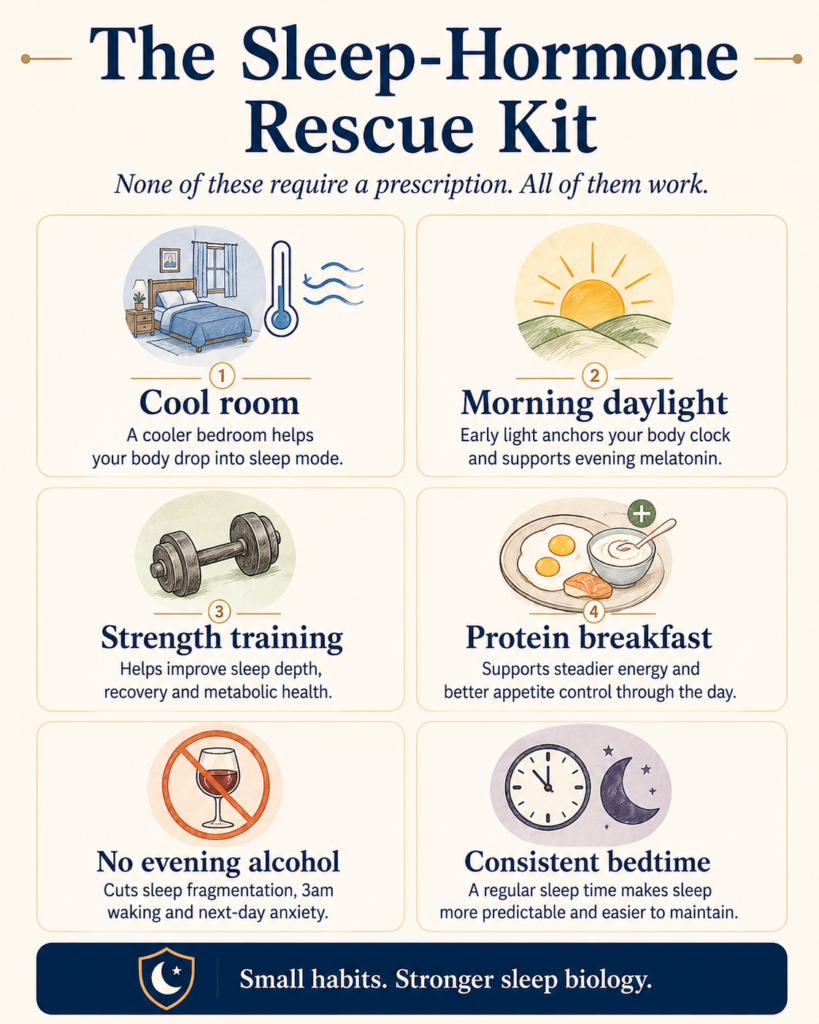
The good news is that a significant portion of the sleep-hormone problem is addressable through non-medical interventions. Not all of it — and anyone who tells you that lifestyle alone will fix severe menopausal insomnia is not being honest. However, for many people, the following work genuinely well.
| Intervention | What It Actually Does | Realistic Impact |
|---|---|---|
| Resistance training (2x weekly) | Supports testosterone, improves insulin sensitivity, deepens sleep | ✅ Genuinely significant |
| Cool bedroom (16-18°C) | Reduces night sweats, supports deep sleep | ✅ High return for the effort |
| No alcohol after 6pm | Reduces cortisol spikes, protects deep sleep | ✅ Underrated impact |
| Consistent bed/wake time | Stabilises cortisol rhythm and melatonin timing | ✅ Foundational |
| Morning daylight (10+ mins) | Anchors circadian rhythm, improves evening melatonin | ✅ Free, effective |
| Strength + protein at breakfast | Supports muscle mass, hormone production, satiety | ✅ Compound benefit |
| Magnesium glycinate (evening) | Mild sedative effect, muscle relaxation | ⚠️ Modest but real |
| Melatonin supplementation | Directly replaces declining hormone | ⚠️ Genuinely helps some people |
Two things are worth pulling out of that table. First, strength training is the single most underrated intervention for sleep after 50. It supports testosterone in men, insulin sensitivity in everyone, and produces measurable improvements in sleep quality even in the absence of any other change. Two 45-minute sessions a week is enough — you can read the detail in our piece on strength training after 50.
Second, alcohol is the biggest hidden saboteur of sleep in this age group, and one that even careful people often underestimate. A glass or two of wine feels like it helps you fall asleep — because it does. However, it dramatically fragments the deep sleep during which most of your hormonal reset happens. As we explored in our recent piece on how drinking to cope with stress rewires the brain, the biological cost is genuinely substantial — and it lands harder as you age.
The Wider Picture — Why This Matters More Than Just Tiredness
It’s tempting to see hormonal sleep disruption as an inconvenience — irritating, tiring, but ultimately survivable. However, the biological cost is real and worth taking seriously. Chronic poor sleep after 50 is associated with significantly increased risk of cardiovascular disease, type 2 diabetes, dementia, and depression. It also directly accelerates biological ageing at a cellular level, through mechanisms including telomere shortening and increased systemic inflammation.
Fixing your sleep isn’t a lifestyle luxury — it’s genuinely one of the highest-leverage things you can do for longevity. As we’ve argued in our overview of how to slow biological ageing naturally after 50, sleep sits alongside strength training, nutrition, and social connection as one of the four foundational pillars of healthy ageing. The others don’t fully compensate when sleep collapses. It’s that central. Our deeper dive into why is in our piece on the importance of sleep for longevity.
FAQ — Things People Actually Ask
Why do I wake at 3am every night no matter what I do?
The 3am wake is almost certainly a cortisol spike — a sudden rise in stress hormone in the early hours that overrides your body’s sleep signals. It’s very common in perimenopause and midlife more broadly, and it’s driven by the combination of shifted cortisol rhythm, reduced melatonin, and — in women — declining progesterone. Fixing it usually requires attention to the whole picture: alcohol, evening stress, consistent bedtime, and morning daylight all matter. In some cases, HRT resolves it directly. If it persists despite these interventions, a GP conversation is worth having.
Is HRT actually safe? I keep hearing conflicting things.
The current evidence is clearer than the confused public conversation would suggest. For most women who begin HRT within 10 years of menopause and use it for a defined period, the benefits significantly outweigh the risks. The frightening findings from the 2002 Women’s Health Initiative study turned out to be largely specific to older women starting HRT well past menopause. Modern low-dose formulations, transdermal delivery, and body-identical hormones have further improved the safety profile. The conversation to have with your GP is not “is HRT safe” but “is HRT right for me, given my specific health history and symptoms.”
Should men be taking testosterone?
Only after a proper blood test showing genuinely low levels and only under medical supervision — testosterone replacement isn’t a routine longevity intervention and it’s not without risks or side effects. However, if you’re a man over 50 with persistent fatigue, low mood, reduced libido, poor sleep, and reduced strength that doesn’t respond to lifestyle changes, asking your GP for a testosterone blood test is a legitimate request. Many men with genuinely low levels benefit significantly from replacement — but many others who feel similarly turn out to have normal levels and need to address other factors.
What’s the single most important thing I can do this week?
Get outside within 30 minutes of waking, without sunglasses, for at least 10 minutes — even if it’s cloudy. Morning daylight is the single most powerful signal your body has for anchoring its circadian rhythm, and it directly improves evening melatonin release. This one habit, done consistently, produces measurable improvements in sleep quality within a week or two — and it costs nothing.
One Thing to Do This Week
Track your sleep for seven days — not with a wearable necessarily, just a simple note each morning. What time you went to bed. What time you fell asleep. How many times you woke. When you finally got up. And crucially, one small note about the day before: any alcohol, any late meals, any late screens, any significant stress. Because the pattern that emerges over a week tells you far more about what’s actually affecting your sleep than any single night can. Awareness is where useful change starts.
Want to Go Deeper?
If this has made you want to understand more about the wider picture of what’s happening to your body after 50 — and what you can actually do about it — we’ve put together guides covering sleep, hormones, nutrition, and strength in a practical, evidence-led way.
Browse the full guides library at Slowing the Clock →
Take what’s useful. Leave what isn’t. That’s always the idea.