Botox: How a Deadly Toxin Became a Beauty Staple
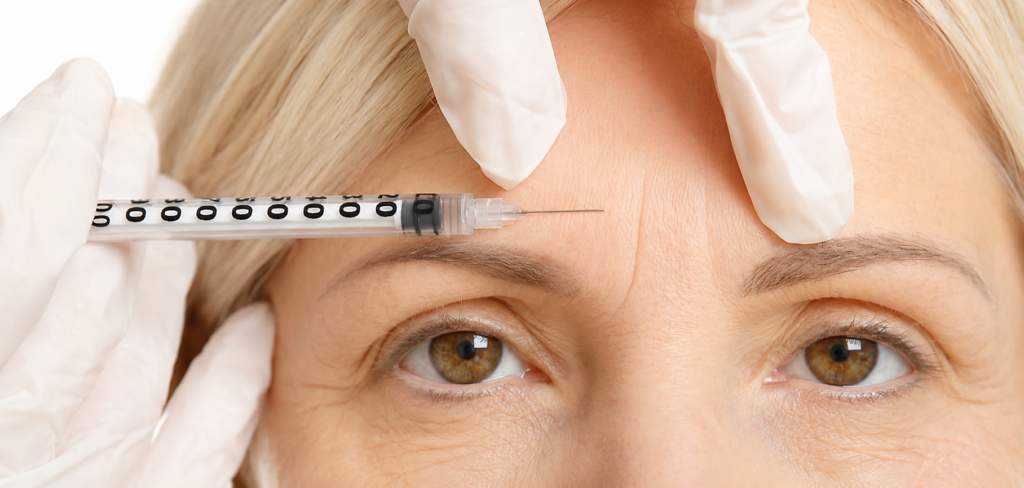
Here’s a fact you can use at your next dinner party. The active ingredient in every Botox injection performed today is derived from a bacterial toxin so lethal that a single gram, properly distributed, could theoretically kill more than a million people. It is, by weight, one of the most poisonous substances known to science — regularly cited in biosecurity literature as a potential weapon of mass destruction. And roughly 900,000 people in the UK alone will pay to have a tiny dose of it injected into their faces this year.
That’s an extraordinary journey for any substance to have made. From nineteenth-century poison, to twentieth-century medical curiosity, to twenty-first-century cultural staple — with more people receiving it in the UK now than have flu jabs in some age groups. Global sales of Botox and its competitors were worth around $5.6 billion in 2023 and are projected to nearly triple by 2032. The UK aesthetics market alone is estimated at £3.2 billion, and botulinum toxin accounts for more than half of the injectables side of it.
However, alongside the extraordinary science story is a growing set of harder questions — about safety, about regulation, about the cultural pressure driving demand, and about what long-term use actually does to your face and to the muscles beneath it. This piece is written to give you the full picture, honestly and without pushing you in either direction. What you do with the information is up to you.
⚡ What You’ll Learn in the Next 5 Minutes
- The genuinely astonishing history of how a lethal toxin became a beauty industry giant
- The medical uses that most people have completely forgotten about
- The scale of the current boom — and who’s actually administering it
- The safety picture, honestly told — including what’s fine and what’s not
- The under-discussed long-term questions worth thinking about
From “Sausage Poison” to Global Blockbuster
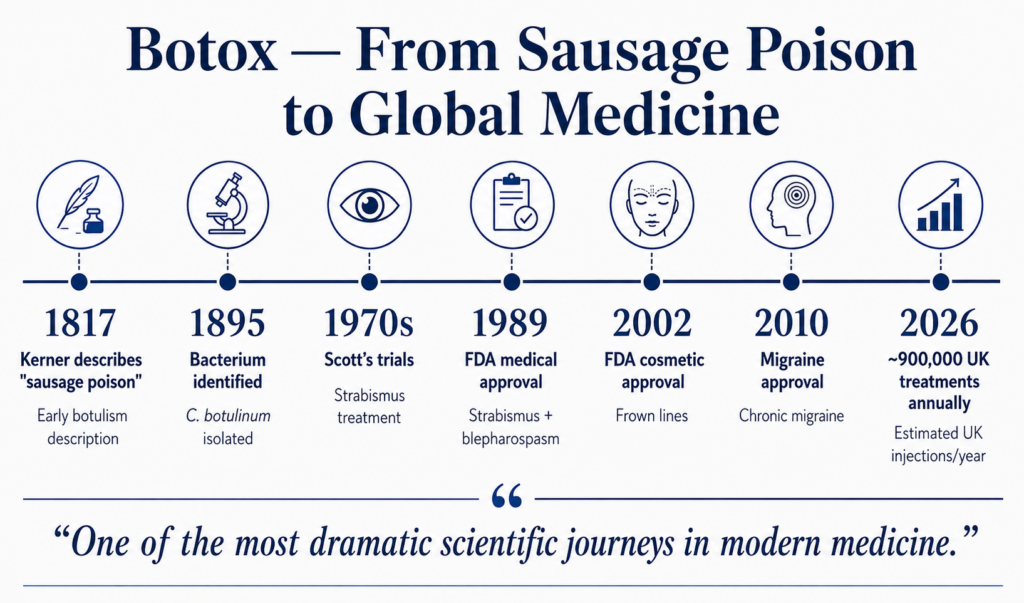
The story begins in early nineteenth-century Germany with a German physician named Justinus Kerner. Between 1817 and 1822, Kerner investigated a series of fatal food poisonings caused by badly preserved sausages — deaths characterised by muscle paralysis and, ultimately, respiratory failure. He gave the mysterious poison a name derived from the Latin word for sausage: botulus. Botulism. Kerner even predicted, with striking foresight, that the poison might one day have medical uses if it could be extracted and administered in tiny controlled doses.
It took another sixty years to identify the culprit — a bacterium later named Clostridium botulinum, isolated in 1895 by a Belgian bacteriologist investigating another sausage poisoning outbreak. The toxin the bacterium produces works with terrible efficiency: it blocks the release of acetylcholine, the chemical signal that tells muscles to contract. Muscles that can’t receive signals can’t move. In a full poisoning, that means the muscles of breathing eventually stop working.
What transformed botulinum toxin from public health threat to therapeutic breakthrough was the observation, over decades of research, that the same paralysing effect could be extraordinarily useful in tiny controlled doses. If you could target a specific overactive muscle and quieten it precisely, you could treat everything from crossed eyes to painful muscle spasms. In the 1970s, an American ophthalmologist named Alan Scott began experimenting with purified botulinum toxin as a treatment for strabismus (misaligned eyes) — and it worked. The FDA approved it for that medical use in 1989. Its dermatological potential was discovered almost by accident: patients being treated for eye conditions started noticing that the frown lines between their eyebrows had softened. In 2002, the FDA approved Botox for cosmetic use to smooth glabellar (frown) lines. The rest, as they say, is billion-dollar history.
The Medical Uses That Get Forgotten
The cosmetic conversation has now become so dominant that most people don’t realise how many genuinely important medical conditions Botox is used to treat. These indications aren’t fringe — they’re mainstream medicine, prescribed by neurologists, ophthalmologists, urologists, and pain specialists every day.
- Chronic migraine. Approved in 2010, Botox injections around the head and neck significantly reduce migraine days for many sufferers who haven’t responded to other treatments. For some, it’s genuinely life-changing.
- Muscle spasticity in cerebral palsy and stroke recovery. Targeted injections reduce painful, function-limiting muscle contractions and help preserve mobility.
- Overactive bladder. Botox injected into the bladder wall reduces urgency and incontinence in people who don’t respond to other treatments.
- Hyperhidrosis (excessive sweating). Injections into the armpits or palms can effectively stop sweating for months at a time.
- TMJ disorders and bruxism (teeth grinding). Reduces muscle tension in the jaw, easing pain and preventing tooth damage.
- Cervical dystonia. A painful neurological condition causing involuntary neck muscle contractions — Botox is a first-line treatment.
- Blepharospasm and strabismus. The original medical uses — treating involuntary eyelid spasms and eye misalignment.
The therapeutic side of the Botox market, though smaller than the cosmetic side, is genuinely enormous and growing rapidly. For anyone considering Botox purely for cosmetic reasons, it’s worth knowing that the same drug is being used, in the same clinics sometimes, to help people function in daily life. That context tends to be missing from the aesthetic conversation.
The Scale of the Boom
The numbers are worth pausing on for a moment because they tell a story that’s more dramatic than most people realise.
The UK aesthetic injectable market was worth roughly £493 million in 2025 and is projected to more than double by 2033. Botulinum toxin alone accounts for around 50% of that revenue and represents 9 out of every 10 aesthetic procedures performed in the country. Approximately 900,000 Botox treatments are administered annually in the UK — a figure that has grown exponentially in the last decade.
The demographic picture has shifted dramatically too. What was once the preserve of Hollywood and wealthy older women is now a mainstream service used across generations. UK data suggests the highest demand now sits with women aged 25-40 — a decade earlier than the traditional user base. “Baby Botox,” which uses smaller doses for a more subtle effect, has become one of the fastest-growing trends of 2026 and has significantly lowered the psychological threshold for first-time users.
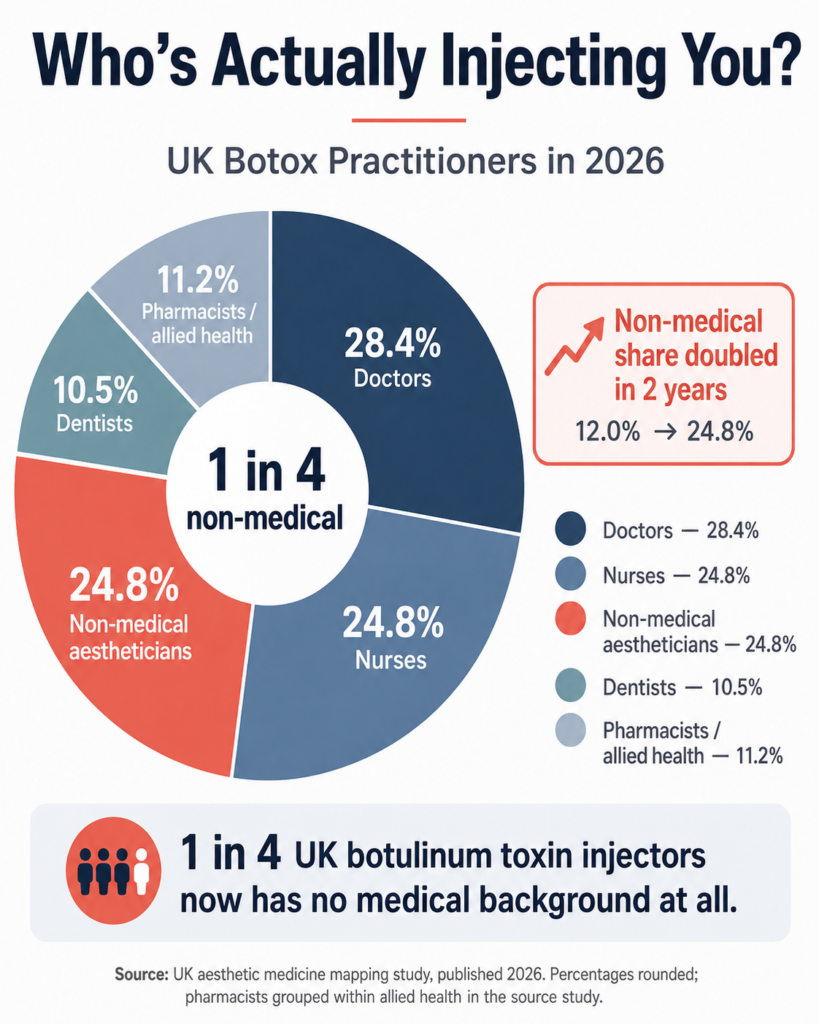
What’s genuinely striking is who’s providing these treatments. A 2026 University College London study — the most comprehensive mapping of the UK sector to date — identified 19,701 practitioners working across 5,589 UK clinics. That’s up from 3,667 practitioners in a 2023 count, though the researchers note some of the increase reflects better identification of previously invisible online and social-media-based providers.
The really important finding was who these practitioners are. Between 2023 and 2025, the proportion of botulinum toxin injectors without any medical background at all doubled from around 12% to nearly 25%. Medical doctors now account for under a third of practitioners. The rest are a mixture of dentists, nurses, pharmacists, and — increasingly — beauty therapists with only aesthetic training. As of 2026, in most parts of the UK, there is no legal requirement for a person injecting botulinum toxin to have any medical qualification whatsoever, provided a prescriber has authorised the treatment (which can be done remotely).
Safety — Told Honestly
Here’s where the honest, nuanced picture matters most. Botulinum toxin, administered by a properly trained, medically qualified practitioner, using a licensed product, at appropriate doses, is genuinely one of the safest procedures in modern aesthetic medicine. Serious complications are rare. Most side effects — bruising at the injection site, temporary drooping of an eyelid or brow, mild headache — are minor and self-limiting. In competent hands, it works predictably and reversibly.
However, the safety picture in the UK’s real-world market is considerably more concerning than that ideal scenario suggests. In summer 2025, the UK Health Security Agency issued a national alert following a cluster of botulism cases linked to non-medical aesthetic treatments — patients developed serious systemic paralysis from unlicensed or counterfeit botulinum toxin products injected in non-clinical settings. Some required intensive care. This isn’t a normal complication of properly administered Botox. It’s the direct consequence of an under-regulated market flooded with cheap counterfeit product administered by insufficiently trained providers.
Even with legitimate product, complications are more likely when the injector lacks the anatomical knowledge to place the toxin correctly. Botulinum toxin spreads slightly beyond the injection site, and an injection placed in the wrong plane or at the wrong depth can cause temporary paralysis of muscles you didn’t want to paralyse — including the muscles that control your eyelids, your smile, or your ability to swallow. Most of these effects wear off within weeks to months, but “temporary” can still mean months of visible facial asymmetry.
The UCL research also identified a genuinely troubling socioeconomic pattern. The lowest-priced botulinum toxin treatments — often the ones administered by non-medical practitioners in salons and pop-up settings — cluster more heavily in economically deprived areas. That’s the inverse of what you’d want, in safety terms. The people least able to bear the financial or medical consequences of a botched treatment are the ones most likely to be treated by the least qualified providers.
The UK government announced proposed reforms in early 2026 — a tiered classification system that would require more stringent practitioner standards for injectable treatments. Whether these reforms will be implemented, and how enforceable they’ll prove in practice, remains genuinely uncertain. As things stand today, there is a substantial gap between how Botox works when done properly and how it’s being done at the lower end of the market.
The Questions Nobody Really Asks
Even setting aside the safety and regulation questions, there are some genuinely interesting long-term questions about Botox that rarely feature in the aesthetic industry’s messaging. These are worth thinking about carefully — not because they should necessarily change your decision, but because informed decisions require the full picture.
Muscle atrophy over time. If you regularly paralyse a muscle for months at a time over many years, that muscle will get smaller. Studies of long-term Botox users have shown measurable thinning of the treated facial muscles compared with untreated controls. Whether this matters depends on which muscle — some thinning is aesthetically desirable, some isn’t. However, it’s worth understanding that the effect isn’t purely temporary. Repeated Botox does change facial muscle over time, and once thinned, muscles don’t necessarily bounce back to their previous size when treatment stops.
Skin quality below the muscle. Botox smooths the appearance of wrinkles by relaxing the underlying muscle that creates them. However, it doesn’t improve the skin itself — the collagen, the elasticity, the underlying tissue health. In fact, some dermatologists argue that Botox creates a false confidence in “youthful” appearance while neglecting the more important skin health work that actually determines how skin ages over decades. Our companion piece on what your skin is really telling you covers what actually keeps skin biologically healthy — daily broad-spectrum SPF, adequate sleep, protein, and hydration matter considerably more than any injection.
The “Instagram face” phenomenon. Aesthetic practitioners increasingly report treating patients — often young — who arrive with reference photos of heavily filtered social media images, asking for a face that doesn’t exist in nature. The cumulative effect of injectable treatments in this direction produces a look that some dermatologists have described as “algorithmic homogenisation” — different faces gradually converging toward the same idealised, feature-flattened aesthetic. Whether that’s a problem is genuinely a matter of personal judgement. However, it’s a real phenomenon that people getting their first injections don’t always fully appreciate.
What happens when you stop. Botox’s effects wear off after 3-4 months. When people stop treatment, the muscles that were being paralysed gradually regain their strength, and the wrinkles they created return. For some people, wrinkles look worse initially than before treatment started — because the muscles have been temporarily under-used and take time to rebalance. Long-term users occasionally report psychological difficulty accepting their untreated face, particularly if it looks noticeably older than their heavily treated peers. This isn’t a reason not to start, but it is worth thinking about upfront: for many, the decision to begin Botox becomes a decision to continue it, indefinitely.
The wider healthy ageing picture. Perhaps the most important context is that Botox does exactly one thing — it paralyses muscles. It doesn’t improve skin. It doesn’t slow biological ageing. It doesn’t protect against skin cancer. It doesn’t reduce inflammation, improve sleep, or preserve muscle mass — the actual biological levers that determine how well you age. Our overview of how to slow biological ageing naturally after 50 covers what genuinely does. If someone is investing significantly in Botox while neglecting sleep, nutrition, movement, sun protection, and social connection, they’re solving a smaller problem while ignoring a larger one.
Bringing It All Together — The Informed Decision
None of the above is intended to push you either toward or away from injectable treatments. Some people have Botox and love the results, feel more confident, and experience no meaningful downsides. Some people try it and never repeat. Some people are drawn in by advertising, spend heavily, and find themselves gradually chasing a moving standard. Some people never consider it at all and are perfectly content. All of these are legitimate positions.
What matters is that the decision is genuinely informed. If you’re considering Botox for the first time — or thinking about continuing or expanding existing treatments — the following considerations are the ones the aesthetic industry itself is unlikely to raise with you:
| Consideration | What Actually Matters |
|---|---|
| Who’s injecting you | Medical qualification, anatomical training, and independent regulation status |
| Where they’re operating | CQC-registered clinic vs salon vs pop-up — this matters more than most people realise |
| What product they’re using | Licensed UK brand (Botox, Bocouture, Azzalure, etc) — never unbranded or “grey market” |
| Price that seems too good | Genuinely low-cost Botox is a warning sign, not a bargain |
| Long-term commitment | Realistic understanding that this is an ongoing expense, not a one-off |
| The wider picture | Sun protection, sleep, nutrition, and stress management do more for how you age |
The wider picture matters more than the injection matters. Sleep affects skin quality more than Botox does — as our piece on the importance of sleep for longevity explains. Diet affects inflammation and skin structure more than Botox does — covered in our review of anti-inflammatory diets. Hormonal changes affect skin ageing profoundly — see our piece on how hormones are rewriting your sleep after 50 for how much this quietly affects everything. Botox, in the end, is one small decision inside a much larger picture — and the informed reader is the one who understands both.
FAQ — Things People Actually Ask
Is Botox actually safe?
Administered by a properly qualified medical practitioner using licensed product at appropriate doses, yes — Botox is one of the safest cosmetic procedures available, with a well-established safety record over 40+ years of clinical use. The real-world safety concerns in the UK relate to the unregulated end of the market: non-medical injectors, counterfeit product, and non-clinical settings. The safety of any individual treatment depends far more on who is administering it than on the underlying molecule itself.
How do I check whether a practitioner is properly qualified?
In the UK, look for practitioners registered with the General Medical Council (doctors), Nursing and Midwifery Council (nurses), General Dental Council (dentists), or General Pharmaceutical Council (pharmacists). The clinic should be CQC-registered (Care Quality Commission). Membership of professional bodies such as the British College of Aesthetic Medicine or the British Association of Aesthetic Plastic Surgeons is a positive sign. If someone is unwilling to tell you their qualifications, their prescriber, or where the product came from, walk away.
Does Botox cause the “frozen face” look?
Yes, when used inappropriately — over-dosing or treating too many muscle groups simultaneously produces the flat, expressionless look that’s become culturally iconic. Well-administered Botox in appropriate doses shouldn’t have this effect. This is one of the biggest arguments for choosing a medically qualified practitioner with genuine aesthetic experience — they’re significantly more likely to prescribe conservatively and prioritise natural movement over maximum wrinkle reduction.
What’s the single most important thing I can do this week?
If you’re currently considering Botox or already having it, spend 15 minutes checking that your practitioner is medically qualified, the clinic is CQC-registered, and the product being used is a licensed UK brand. If any of those checks come back with unclear answers, that’s genuinely important information. And whatever you decide about injectables, invest 30 seconds of every morning applying broad-spectrum SPF to your face, ears, neck, and hands — that single habit will do more for how your skin ages over the coming decade than any injection can.
One Thing to Do This Week
Whether Botox is something you already use, are considering, or have decided isn’t for you — this week, take an honest look at the wider picture. Because the aesthetic industry has become so effective at focusing attention on injections that it’s easy to lose sight of the ordinary, unsexy, evidence-based habits that determine how you actually age. Daily SPF. Seven hours of good sleep. Adequate protein. Not smoking. Regular exercise. Genuine social connection. Those six things do more for skin health, energy, and how young you feel and look over a decade than any injectable can. If any of the six is missing from your current life, that’s the actionable takeaway from this piece — regardless of what you decide about Botox itself.
Want to Go Deeper?
If this has made you think about the bigger picture of what actually keeps us looking, feeling, and being well as we age — beyond the noise of the aesthetics industry — we’ve put together guides covering the evidence-based building blocks of healthy ageing. Sleep, nutrition, movement, hormones, and everything in between.
Browse the full guides library at Slowing the Clock →
Take what’s useful. Leave what isn’t. That’s always the idea.