Prostate Health: What Every Man — and Woman — Should Know

Prostate cancer is now the most commonly diagnosed cancer in the UK. Around 55,000 men are diagnosed with it every year, and roughly 12,000 die of it. However, unlike bowel or breast or cervical cancer, there is no national screening programme for prostate cancer in this country. What we have instead is a system that relies on men knowing they can ask for a test, knowing when to ask, and being confident enough to push if the answer is initially “you don’t need one.”
Sir Chris Hoy was diagnosed with terminal stage 4 prostate cancer in 2023 at the age of 47. He had no symptoms. His father and grandfather had both had the disease. However, because the UK doesn’t proactively screen even men with a strong family history, he wasn’t tested. He’s spent the years since campaigning tirelessly for the system to change — and following his advocacy, the UK National Screening Committee is now formally reviewing whether targeted screening should be introduced. A decision is expected in 2026.
Whether or not that review changes things, this piece is written for two audiences. It’s for the men who need to understand their own risk, know what to ask for, and stop assuming that “no symptoms” means “no problem.” And it’s for the women who — statistically, honestly — are often the ones who push their partners toward the GP in the first place. Because when former Prime Minister David Cameron revealed his own prostate cancer diagnosis in 2024, he was clear about how it happened: his wife Samantha encouraged him to get tested. That’s not an unusual story. It’s often exactly how these things unfold.
⚡ What You’ll Learn in the Next 5 Minutes
- The difference between an enlarged prostate and prostate cancer — because they’re not the same thing
- Why prostate cancer is often silent until it’s advanced
- Who’s at highest risk — and why family history matters more than most men realise
- What the PSA test actually is, and how to request one on the NHS today
- Why this conversation often needs a woman to start it
Understanding the Prostate — And What Can Go Wrong
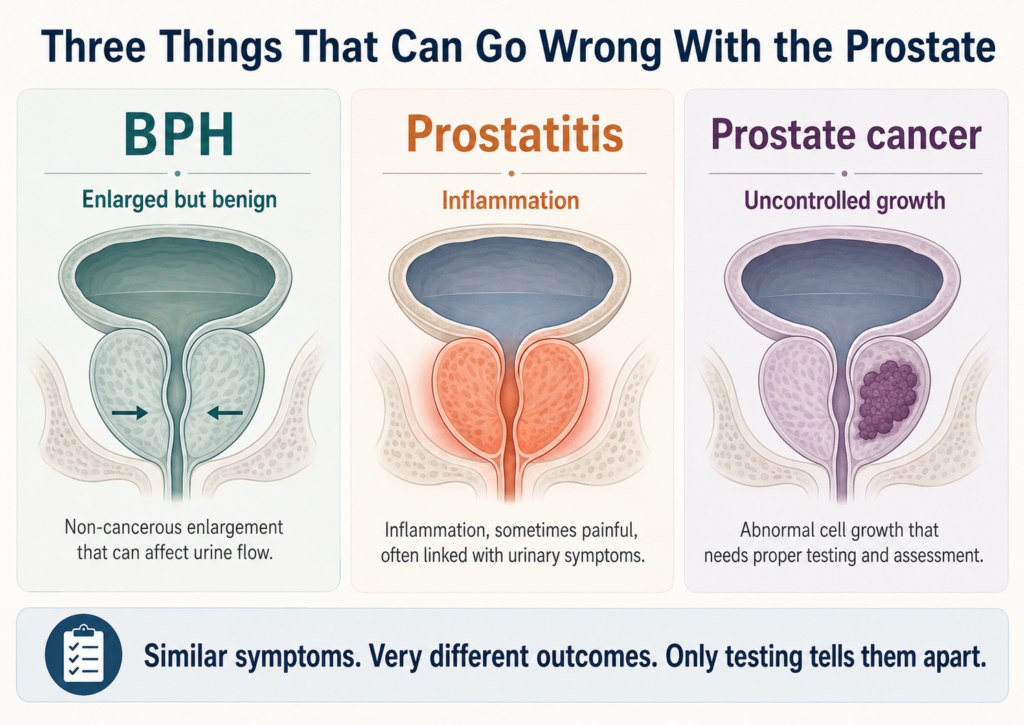
The prostate is a walnut-sized gland that sits below the bladder in men. Its main job is to produce fluid that forms part of semen. It’s small, tucked away, and quietly does its work for most of a man’s life. However, three things commonly go wrong with it as men age, and it’s genuinely important to understand which is which — because they cause similar symptoms but have very different implications.
Benign prostatic hyperplasia (BPH) is the medical name for an enlarged prostate that isn’t cancerous. It’s extremely common — around 50% of men over 60 and 90% of men over 80 will develop it. The prostate simply gets bigger with age, and because it wraps around the urethra (the tube carrying urine out of the bladder), that enlargement can cause frustrating symptoms: needing to pee more often, especially at night, weak or interrupted urine flow, difficulty starting, or a feeling that the bladder hasn’t fully emptied. BPH is not dangerous and doesn’t turn into cancer. However, it can be genuinely disruptive to quality of life, and it’s treatable.
Prostatitis is inflammation or infection of the prostate. It can cause pelvic pain, burning during urination, and flu-like symptoms. It affects men of any age, is usually treatable with antibiotics or anti-inflammatories, and — importantly — is not a marker for cancer.
Prostate cancer is when cells in the prostate begin to grow uncontrollably. Here’s the important part: prostate cancer often causes no symptoms at all in its early stages. The prostate is deep enough in the body that a tumour can grow substantially before it starts to interfere with urination or cause discomfort. By the time symptoms appear, the cancer has often spread beyond the prostate itself. This is precisely why waiting for symptoms is such a dangerous strategy.
When symptoms do appear from prostate cancer, they can look almost identical to BPH — which is part of what makes the situation so confusing. Weak urine flow, needing to pee more often, blood in urine or semen, pain in the back, hips or pelvis. Many of these overlap with the enlarged-but-benign version. The only way to distinguish them reliably is through testing. Guessing based on symptoms alone is not a strategy that works.
Who’s at Highest Risk — And Why It Matters
Every man has some risk of prostate cancer, but the risk isn’t spread evenly across the population. Three factors matter most.
Age. Prostate cancer is uncommon under 50, and roughly 1 in 8 men in the UK will develop it during their lifetime. Most cases occur in men over 65. However — and this is critical — significant numbers occur in men in their 40s and 50s, particularly those with the other two risk factors below. Sir Chris Hoy was 47 at diagnosis.
Family history. This is the risk factor that gets most dramatically underplayed. If your father, brother, or grandfather had prostate cancer — especially if diagnosed before age 60 — your own risk is roughly double the average. If two close relatives have had it, the risk quadruples. This is exactly why Sir Chris Hoy has been so vocal — his father and grandfather both had prostate cancer, and current NHS guidance still doesn’t proactively contact men in that situation. It relies on them, and often their families, knowing to ask.
Ethnicity. Black men have roughly double the lifetime risk of prostate cancer compared with the general UK population — around 1 in 4, compared with 1 in 8. Black men are also more likely to be diagnosed at a younger age and to have more aggressive disease. This is a genuinely significant disparity that receives far too little attention in mainstream health messaging.
Other risk factors that matter but less dramatically include obesity, sedentary lifestyle, and diets high in processed foods. These are lifestyle-based, which means they’re modifiable. The wider picture of what actually reduces cancer risk sits within the broader work of slowing biological ageing naturally after 50 — good general health and cancer risk overlap considerably.
The PSA Test — What It Is and Isn’t
The prostate-specific antigen (PSA) test is a simple blood test that measures a protein produced by the prostate. Raised PSA levels can indicate prostate cancer — but they can also be raised for entirely benign reasons, including BPH, urinary tract infection, recent vigorous exercise, or recent sexual activity. This is why PSA testing isn’t straightforward, and why the NHS hasn’t rolled out universal screening.
The current position is honestly nuanced. PSA testing produces false positives that can lead to unnecessary anxiety and sometimes unnecessary biopsies. It also occasionally produces false negatives — meaning a normal PSA doesn’t guarantee absence of cancer. However, in men at elevated risk — those with family history, Black men, and men over 50 more broadly — the evidence increasingly suggests that the benefits of testing outweigh the risks, particularly when combined with modern diagnostic tools like MRI scanning that reduce the need for invasive biopsies in ambiguous cases.
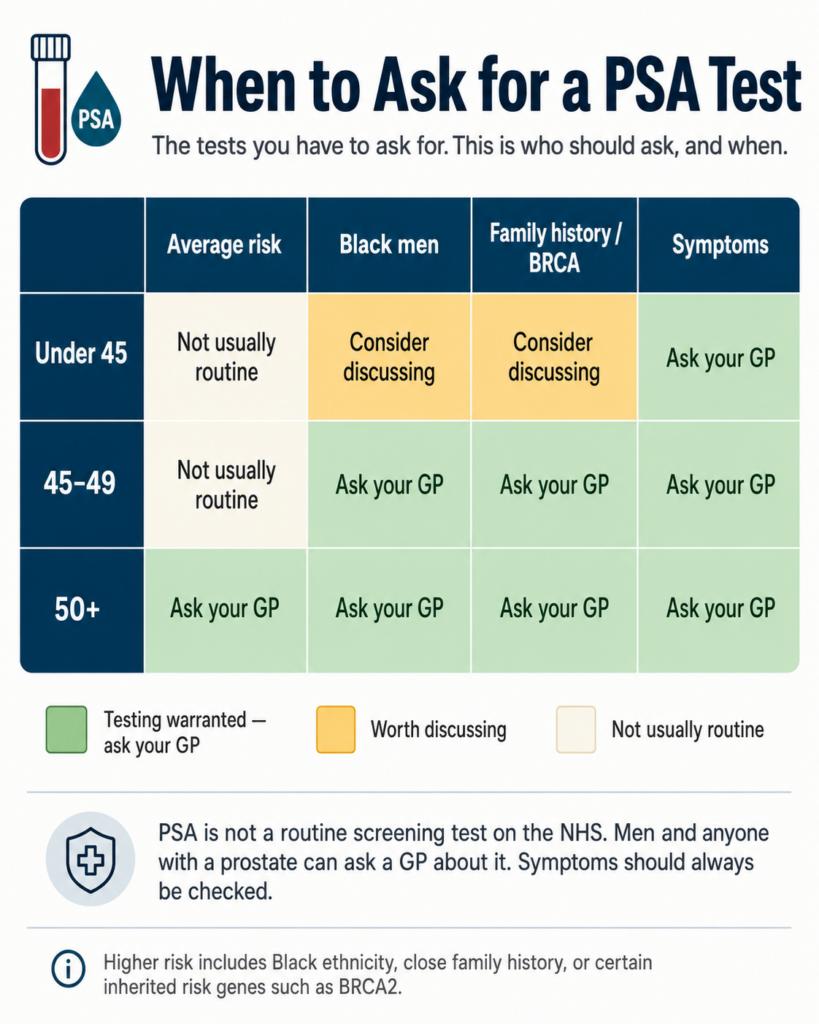
Here’s what matters practically. Any man aged 50 or over can request a PSA test from their GP today, without symptoms, without a referral, without any specific reason beyond wanting to know. This is NHS policy — it’s called the Prostate Cancer Risk Management Programme. Men with a family history can request testing from age 45. Black men are advised to consider testing from 45 given their elevated risk. However, these tests will not typically be offered proactively. You have to ask.
The exact form of words that gets past a busy GP most reliably: “I’m over 50 [or ‘I’m over 45 and my father/brother had prostate cancer’] and I’d like a PSA test under the Prostate Cancer Risk Management Programme.” Those specific words signal that you know the policy exists and that you’re making an informed request. Our companion piece on the health checks worth asking for after 50 covers exactly how to have these conversations effectively.
Treatment — And Why Early Detection Changes Everything
The gap between prostate cancer caught early and prostate cancer caught late is genuinely dramatic — and it’s the strongest single argument for why the “ask for a test” conversation matters so much.
Stage 1 or 2 prostate cancer (cancer contained within the prostate) has a five-year survival rate of essentially 100%. Treatment options range from active surveillance (monitoring without immediate intervention, appropriate for many slow-growing early cancers) through to surgery, radiotherapy, or focal treatments that target only the tumour. Recovery is typically good, side effects are manageable, and quality of life afterwards is generally excellent.
Stage 4 prostate cancer (cancer that has spread beyond the prostate to other parts of the body) has a five-year survival rate of around 50%. Treatment is longer-term, more disruptive, and focused on control rather than cure. This is the stage Sir Chris Hoy was diagnosed at — his cancer had already spread to his bones by the time it was found.
Same cancer. Very different biology. The only meaningful difference is when it was caught.
What makes this particularly poignant is that most stage 4 prostate cancers were, at some earlier point, stage 1 cancers that could have been treated successfully. The window where intervention is easy and highly effective is exactly the window that regular testing is designed to catch — and it’s the window that gets missed when men wait for symptoms.
For the Women Reading This
Here’s a genuine truth of modern health behaviour, and it deserves to be named clearly. Women are significantly more likely than men to visit their GP, to notice health changes in family members, and to be the ones initiating conversations about screening and prevention. Multiple studies confirm this. Men — particularly men over 50 who came of age when “just get on with it” was the dominant cultural script — often actively avoid GP appointments until symptoms become impossible to ignore. By then, in the case of prostate cancer, it’s often too late for the easy treatment window.
David Cameron’s account of his own diagnosis makes this pattern completely explicit. In interviews after revealing his prostate cancer, he was clear that his wife Samantha was the one who encouraged him to get tested. His story isn’t unusual — it’s typical. In many households, the health advocate is the woman, and men who would never book themselves a GP appointment will grudgingly go along when their partner books it for them.
If you’re reading this and there’s a man in your life over 45 with a family history of prostate cancer, or over 50 without one, this piece is at least half addressed to you. It might be worth:
- Asking whether he’s ever had a PSA test — most men who haven’t don’t know they should
- Sharing this article with him, or sending him to Prostate Cancer UK’s 30-second risk checker
- Suggesting he book a routine GP appointment and mention it there
- Being the one who books the appointment if that’s the pattern in your relationship
Nothing here is nagging. It’s the recognition that most men over 50 will not proactively raise this with their GP unless something prompts them — and that something is very often their partner, their sister, their daughter, or their mother.
For men reading who might otherwise skim past this section: David Cameron’s story doesn’t make either of you weak. It reflects a well-documented behavioural pattern. Being willing to be prompted is a strength, not a weakness. Ask the woman in your life to remind you. Take her seriously when she does.
What You Can Do Beyond Testing
Testing is the most important single intervention, but it’s not the only one. The lifestyle factors that reduce cancer risk generally also reduce prostate cancer risk specifically. None of these are alternatives to testing — they sit alongside it.
| Intervention | Evidence Strength | Practical Value |
|---|---|---|
| Ask for a PSA test if eligible | Very strong for early detection | ✅ Highest single intervention |
| Regular exercise (esp. resistance training) | Strong — active men have lower risk | ✅ Multiple health benefits |
| Anti-inflammatory diet (Mediterranean-style) | Good — reduces overall cancer risk | ✅ Foundational |
| Maintain healthy weight | Strong — obesity linked to aggressive disease | ✅ High return |
| Limit alcohol | Moderate — heavy drinking raises risk | ✅ Broad benefit |
| Tomato/lycopene-rich diet | Modest — some protective association | ⚠️ Emerging evidence |
| Prostate supplements (saw palmetto etc) | Weak — limited evidence for cancer prevention | ⚠️ Marketing over substance |
Exercise deserves particular attention. Multiple large studies now show that men who regularly do resistance training and moderate cardiovascular exercise have significantly lower risk of aggressive prostate cancer — the type that actually threatens life. The mechanisms include reduced systemic inflammation, better insulin sensitivity, and healthier hormonal profiles. Our piece on strength training after 50 covers the practical details of building this into your week.
Diet matters too, though less dramatically than exercise. A Mediterranean-style eating pattern — rich in vegetables, fruits, whole grains, olive oil, fish, and legumes, with limited processed food and red meat — is consistently associated with lower cancer risk generally. Our piece on anti-inflammatory diets goes into what actually works and what’s overhyped.
Hormonal health also plays a role that’s often overlooked. Testosterone declines with age in most men, but the picture is complex — very high testosterone doesn’t cause prostate cancer, but the interaction between testosterone, other hormones, and prostate tissue is subtle and worth understanding. Our companion piece on how hormones are rewriting your sleep after 50 covers the wider picture of hormonal changes in men and how they interact with sleep, mood, and general wellbeing.
The Bigger Picture — Advocacy and Change
Sir Chris Hoy has been remarkably clear about what he wants to change. It’s not just that men should be more proactive about testing — though they should be. It’s that the system itself should be more proactive about identifying and contacting high-risk men. His argument, echoed by Prostate Cancer UK and increasingly by policymakers, is that leaving early detection entirely to individual initiative means people will die who didn’t need to. Particularly men from communities less likely to challenge medical authority, less confident advocating for themselves, less connected to health information sources.
Following Sir Chris’s campaigning and similar advocacy from figures including former Prime Minister David Cameron and actor Stephen Fry, the Health Secretary ordered a review of NHS prostate cancer testing guidance. The UK National Screening Committee is now formally reviewing whether targeted screening should be introduced for men at highest risk — those with family history and those from Black ethnic backgrounds. A decision is expected during 2026. Whether or not the review results in system-wide change, the conversation itself has already saved lives. Prostate Cancer UK reports significantly increased use of their online risk checker following Sir Chris’s public advocacy. Referral rates for suspected prostate cancer have risen measurably. Men who might otherwise have died of undiagnosed disease are being diagnosed earlier, in the treatable window.
That’s what public advocacy can do. Meanwhile, individual advocacy — one man requesting a test, or one wife or daughter or son suggesting he does — continues to be the most reliable way early detection actually happens in individual lives.
FAQ — Things People Actually Ask
If prostate cancer is often slow-growing, why does early detection matter so much?
Because not all prostate cancer is slow-growing. Some tumours grow slowly and would never cause problems in a man’s lifetime — this is why active surveillance is a legitimate option for many early cancers. However, aggressive prostate cancers do exist, and they can spread quickly. The only way to know which type you have is to detect the cancer, characterise it (usually through further tests including MRI and sometimes biopsy), and make an informed decision from there. Waiting for symptoms doesn’t distinguish slow from aggressive — it just delays the diagnosis of both.
What if my GP refuses to give me a PSA test?
Under NHS policy, any man aged 50 or over is entitled to request a PSA test — this is the Prostate Cancer Risk Management Programme. If you meet the criteria and your GP refuses, you’re entitled to ask why in writing, request a second opinion from another GP in the practice, or raise it with the practice manager. Reference the Prostate Cancer Risk Management Programme by name. In practice, most GPs will agree once they realise the patient knows the policy exists.
My father had prostate cancer at 65. Am I at risk?
Yes — roughly double the average risk. Current guidance suggests you should consider testing from age 45 rather than waiting until 50, and having an informed discussion with your GP about frequency of testing thereafter. If your father was diagnosed under 60, or if multiple close relatives have had prostate cancer, your risk is higher still and testing may be warranted earlier and more regularly. Have this conversation with your GP explicitly.
What’s the single most important thing I can do this week?
If you’re a man over 50, or over 45 with a family history or of Black ethnic background — book a GP appointment this week and request a PSA test under the Prostate Cancer Risk Management Programme. If you’re a woman with a man in your life who fits any of those criteria and hasn’t been tested, share this article with him. If he’s likely to ignore it (many will), book the appointment for him. This isn’t dramatic — it’s just the truth of how these things often get done.
One Thing to Do This Week
Whether you’re a man or a woman reading this, do this one thing: go to Prostate Cancer UK’s 30-second risk checker and complete it — for yourself, or for the man in your life. It takes less than a minute. It tells you clearly whether you (or he) should be having a conversation with a GP. That single act, based on data rather than assumption, is where meaningful change starts. And if the answer is that testing is warranted, book the appointment before you close this browser tab. Not next month. Not “when things quieten down.” This week.
Want to Go Deeper?
If this has prompted you to think about health more proactively — for yourself or for someone you love — we’ve put together guides covering the wider picture of what genuinely keeps us healthier and living longer. Nutrition, movement, sleep, hormones, and how to actually advocate for yourself in a busy healthcare system.
Browse the full guides library at Slowing the Clock →
Take what’s useful. Leave what isn’t. That’s always the idea.