The Sleep Sign That May Predict Alzheimer’s Years Before Symptoms — And What You Can Do About It

Here’s a small, unnerving finding that landed last month and hasn’t received nearly the attention it deserves. Researchers at the University of Liège in Belgium studied the sleep patterns of more than 500 healthy adults — none of them showing any signs of memory loss or cognitive decline — and found that in the middle-aged group, one specific pattern of sleep disturbance was clearly linked to a higher genetic risk of Alzheimer’s disease. The pattern in question is called nocturnal micro-awakenings: very brief bursts of brain activity during the night that fragment your sleep without actually waking you up. You don’t remember them the next morning. You might not even feel especially tired. However, they may be quietly telling on you decades before dementia symptoms would appear.
The study, published in the journal Sleep in August 2026, is important not because it’s a definitive answer — it isn’t — but because it may point toward one of the earliest possible windows for detecting Alzheimer’s vulnerability. And crucially, sleep is one of the few things we can genuinely influence with our own choices. If disrupted sleep in your 50s and 60s really does reflect underlying brain vulnerability, then improving it isn’t just about feeling more rested. It may be one of the more important things you can do for your long-term cognitive future.
Let’s unpack what the research actually showed, why it matters, and — most importantly — what you can practically do about it.
⚡ What You’ll Learn in the Next 5 Minutes
- What micro-awakenings actually are — and why you probably don’t know you’re having them
- What the new research really found (with honest caveats)
- The biological mechanism linking sleep fragmentation to Alzheimer’s risk
- Why this window of opportunity matters so much in your 50s and 60s
- The specific, evidence-based interventions that reduce sleep fragmentation
What Micro-Awakenings Actually Are
A normal night’s sleep isn’t one long continuous state. It’s a cyclical journey through several stages — light sleep, deep sleep, REM sleep — that repeats roughly every 90 minutes. Even in a completely healthy sleeper, there are brief moments of arousal between cycles. What researchers call micro-awakenings, however, are something different: very brief bursts of brain activity that interrupt the natural flow of sleep without ever crossing the threshold into conscious wakefulness.
Because you don’t consciously wake up, you have no memory of them the next morning. You might sleep a full seven hours and feel reasonably rested — yet spent the night having your deep sleep fragmented dozens of times. The only way to detect them reliably is with an electroencephalogram (EEG) that records brain activity throughout the night.
This is one of the more frustrating aspects of sleep science generally: the sleep you experience and the sleep you’re actually getting can be quite different things. Someone who thinks they’re sleeping well may in fact be having significantly disrupted deep sleep — and the biological consequences don’t care whether you noticed.
What the Belgian Study Actually Found
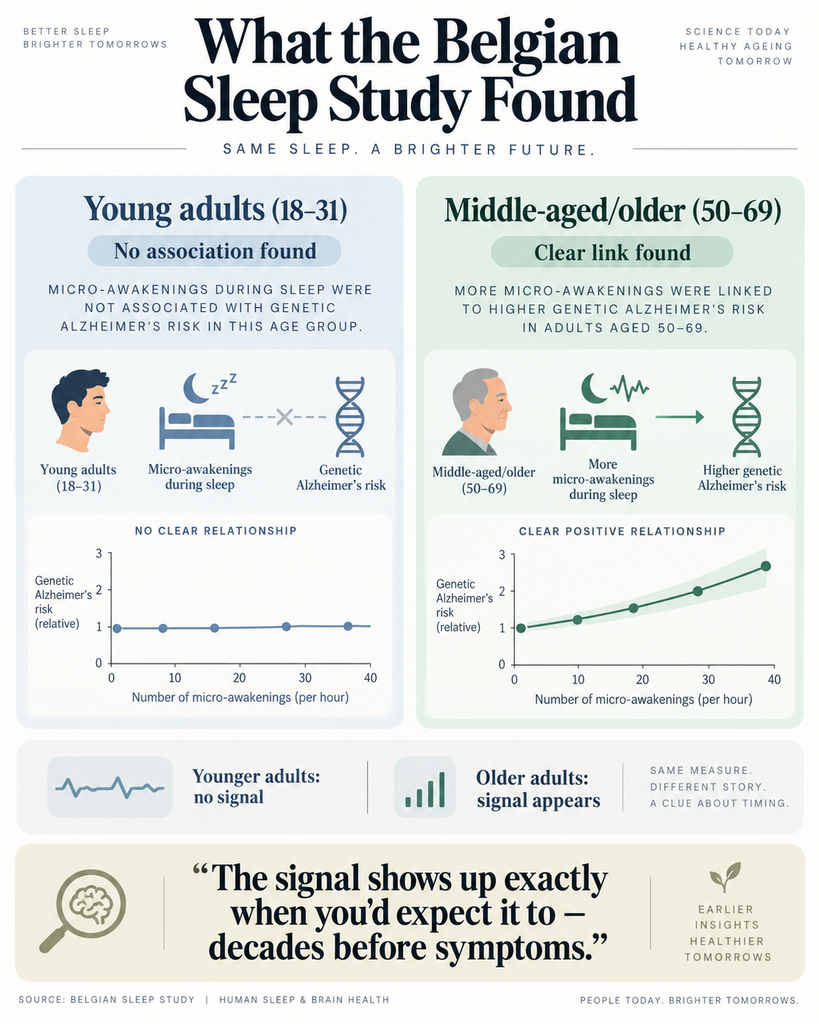
The University of Liège team, working with the Stop Alzheimer’s Foundation, recruited more than 500 healthy volunteers — split roughly into two groups. The younger cohort was aged 18–31. The older cohort was aged 50–69. None had any diagnosed cognitive problems. Their sleep was monitored using EEG to track brain activity through the night, including micro-awakenings that participants themselves weren’t aware of.
Alongside this, researchers calculated each participant’s polygenic risk score for Alzheimer’s disease — a summary of the many small genetic variations that collectively raise or lower a person’s inherited vulnerability to the condition.
The result was clear in one age group and absent in the other. Among the younger participants, there was no association between micro-awakenings and Alzheimer’s genetic risk. However, among the middle-aged and older participants (particularly in the 50-69 age band), those with a higher genetic risk of Alzheimer’s had significantly more frequent micro-awakenings — despite being completely healthy and asymptomatic.
In other words, the sleep pattern seems to become an early biological signal precisely in the age window when Alzheimer’s-related brain changes are believed to begin, but decades before any memory symptoms would appear. And it’s showing up in people who, on the surface, seem completely well.
Now for the honest caveats, because they matter. The older-adult sub-group was relatively small (around 87 people). The study shows association, not causation — micro-awakenings don’t necessarily cause Alzheimer’s risk, they may simply reflect early changes in the same brain regions where the disease begins. Genetic risk is not destiny either: someone with a high polygenic risk score doesn’t automatically develop Alzheimer’s, and someone with low risk isn’t necessarily protected. And even people with lots of micro-awakenings may never develop cognitive problems. This is early research, and further studies with larger samples are needed to confirm what’s been observed.
That said — the biological plausibility is genuinely strong. There are good reasons to think this signal is real.
The Biology — Why Sleep and Alzheimer’s Are So Deeply Linked
To understand why fragmented sleep may be one of the earliest signals of Alzheimer’s risk, you need to know what your brain is actually doing at night — and specifically, what deep sleep does that no other state can.
During deep, slow-wave sleep, your brain activates something researchers have named the glymphatic system — essentially a waste-clearance network that flushes metabolic byproducts out of brain tissue. One of the substances cleared during this process is a protein called beta-amyloid, which is the primary component of the plaques that accumulate in the brains of Alzheimer’s patients. In healthy young adults, deep sleep clears these proteins efficiently every night. In older adults, and particularly in those with early Alzheimer’s-related changes, this clearance process becomes progressively less efficient.
Here’s where micro-awakenings become important. Every time your sleep is fragmented — even briefly, and even if you don’t consciously wake — you’re interrupting the deep-sleep processes that clear brain waste. Over years and decades of fragmented sleep, small quantities of beta-amyloid accumulate that would otherwise have been swept away. Over time, these deposits form the plaques that eventually disrupt neural function.
What makes the Belgian findings so intriguing is that they suggest a two-way relationship. People with higher genetic vulnerability to Alzheimer’s may already be experiencing subtle changes in the brain regions that regulate sleep architecture — including the locus coeruleus, a tiny brain region involved in both sleep and arousal. So the disrupted sleep may be an early consequence of very early biological changes. However, disrupted sleep then compounds the problem by preventing full amyloid clearance, potentially accelerating the underlying vulnerability. It’s a self-reinforcing loop that gets progressively harder to break the longer it continues.
None of this is entirely new territory — the connection between sleep quality and dementia risk has been building for years. What’s new here is the specific mechanism (micro-awakenings measured by EEG), the age window (specifically middle age), and the biological logic that this signal appears precisely when we’d expect early Alzheimer’s-related changes to be starting. For a deeper look at how sleep affects biological ageing more broadly, our piece on the importance of sleep for longevity covers the wider picture in some depth.
Why This Age Window Matters So Much
Here’s something worth sitting with for a moment. Alzheimer’s disease doesn’t begin the day someone starts forgetting names. The underlying brain changes — the amyloid accumulation, the neural inflammation, the synaptic dysfunction — begin 15 to 20 years before any noticeable memory problems appear. In practical terms, that means the biological groundwork for a case of Alzheimer’s diagnosed at 75 was being laid down in someone’s late 50s and early 60s.
That’s genuinely frightening — but it’s also, arguably, the most hopeful piece of information in the entire field. Because if the disease is already quietly underway in your 50s and 60s, then interventions during your 50s and 60s are the ones with the greatest capacity to change the trajectory. Once dementia is clinically apparent, the damage is largely done and reversal becomes extremely difficult. Before symptoms appear, the brain still has enormous capacity for repair, protection, and adaptation.
What the Belgian research suggests, alongside a growing body of similar findings, is that your 50s and 60s are the window in which sleep quality may matter most for long-term brain health. Not just for how alert you feel tomorrow — but for what your brain looks like in 2045.
The added complication for people in this age bracket is that sleep quality is often already deteriorating due to hormonal changes. As we’ve explored in our piece on how your hormones are rewriting your sleep after 50, dropping oestrogen, progesterone, and testosterone all fragment sleep in their own ways. Cortisol rhythm shifts too. The result is that just when sleep quality matters most, most people over 50 are experiencing the natural biological forces that make it harder to achieve.
What Actually Worsens Sleep Fragmentation
Not all sleep fragmentation is genetic. In fact, a substantial portion of it is caused by things entirely within our control — which is where the actionable side of this research becomes real.
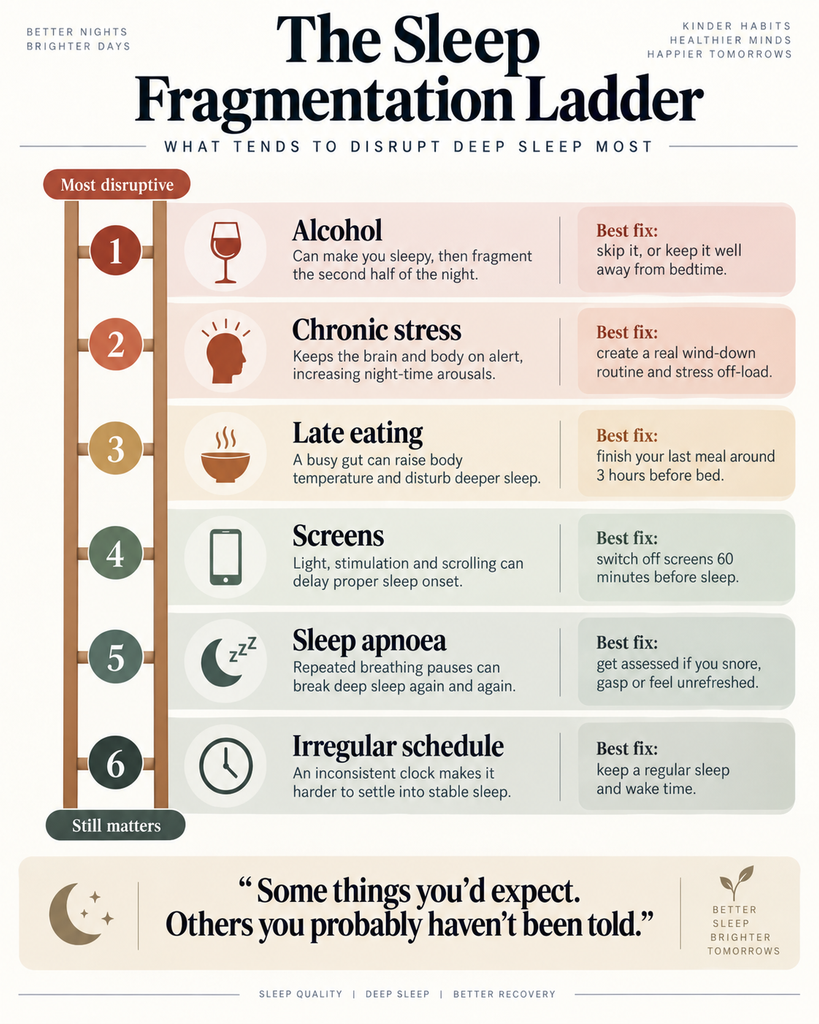
The single biggest cause of preventable sleep fragmentation in adults over 50 is alcohol. This is worth emphasising because most people who drink moderately in the evening genuinely believe it helps them sleep — and in the sense that alcohol does help you fall asleep, they’re right. However, the effect on sleep quality is the opposite. Alcohol dramatically increases the number of micro-awakenings throughout the night, particularly in the second half. Deep sleep is fragmented. REM sleep is suppressed. The person wakes feeling unrested despite having spent the usual hours in bed. Our piece on how drinking to cope with stress is rewiring your brain covers this in more detail.
The next largest driver is chronic stress and elevated cortisol. When your baseline cortisol is elevated — from work pressure, financial worries, ongoing family stress, or simply the accumulated hum of modern life — the natural nightly drop in cortisol that should allow deep sleep is blunted. Sleep becomes lighter, more fragmented, and easier to disturb.
Late eating and blood sugar swings also matter. Eating a substantial meal within three hours of bedtime raises core body temperature and provokes insulin activity that fragments sleep. Blood sugar drops in the small hours can trigger micro-awakenings too — one reason people sometimes wake at 3am feeling wired.
Screens and blue light exposure in the hour before bed reduce melatonin release and delay deep sleep onset. Because deep sleep is concentrated in the first half of the night, anything that delays its start compresses the total amount you get.
Sleep apnoea is worth mentioning separately because it’s dramatically underdiagnosed in adults over 50, especially in women. Untreated sleep apnoea causes hundreds of micro-awakenings per night as breathing repeatedly disrupts sleep. It’s also independently linked to significantly higher dementia risk. If you snore heavily, wake feeling unrested despite a full night in bed, or your partner has noticed you stopping breathing in your sleep, this is worth raising with your GP.
What Actually Helps — Evidence-Based Interventions
Because sleep quality is one of the few things about brain ageing you can genuinely influence, the practical interventions here matter more than most. These aren’t lifestyle tweaks — they’re arguably some of the highest-leverage things you can do for long-term cognitive health.
| Intervention | What It Does | Effort vs Impact |
|---|---|---|
| No alcohol within 3 hours of bed | Reduces micro-awakenings significantly | ✅ Highest impact single change |
| Consistent bed/wake time (including weekends) | Stabilises circadian rhythm and deep sleep timing | ✅ Foundational |
| Regular resistance training | Deepens slow-wave sleep, reduces awakenings | ✅ Compound benefits |
| Cool bedroom (16-18°C) | Supports deep sleep, reduces night sweats | ✅ High return, low effort |
| Morning daylight (10+ mins within 30 mins of waking) | Strengthens circadian signalling, improves evening melatonin | ✅ Free, powerful |
| Anti-inflammatory diet | Reduces neuroinflammation that fragments sleep | ✅ Broad brain benefit |
| Sleep apnoea assessment (if snoring) | Identifies and treats major hidden cause | ✅ Potentially transformative |
| Magnesium glycinate (evening) | Mild sedative effect, reduces awakenings | ⚠️ Modest but real |
Two things are worth emphasising. First — the alcohol point cannot be overstated. If you drink most evenings and are worried about long-term brain health, this is probably the single most impactful change available to you. Second — resistance training. Multiple studies now confirm that regular strength training measurably deepens sleep quality, reduces micro-awakenings, and is independently linked to lower dementia risk. Our companion piece on strength training and longevity covers the practical details of building this into your week.
Diet also matters, though its effects on sleep specifically are indirect. Chronic inflammation drives poor sleep quality, and the foods that reduce systemic inflammation reduce sleep fragmentation. Our review of anti-inflammatory diets covers what the evidence actually supports — and what’s oversold.
All of these interventions sit within the broader picture of slowing biological ageing naturally after 50. Brain ageing isn’t separable from body ageing — they’re deeply interconnected biological processes, and interventions that help one help the other.
The Realistic Bottom Line
Let’s be honest about what this research does and doesn’t tell you. It doesn’t tell you that if you have frequent 3am wakings, you’re getting Alzheimer’s. It doesn’t tell you that improving your sleep guarantees you’ll avoid dementia. What it does tell you — and this is genuinely important — is that sleep quality in your 50s and 60s appears to be one of the more sensitive biological signals of how well your brain is coping with the earliest changes of ageing. And it tells you that in the case of Alzheimer’s specifically, the biological groundwork is being laid decades before symptoms appear.
That combination — early biological signal plus long presymptomatic window — is exactly where meaningful interventions can have the greatest effect. You can’t change your genes. You can absolutely change your sleep hygiene, alcohol intake, exercise patterns, stress management, and dietary quality. Multiple large studies now suggest that lifestyle factors may account for approximately 40% of dementia risk across a lifetime. Genes account for a proportion. Age accounts for a proportion. What’s left is largely in your hands.
The most useful way to think about this study, in my view, is not as a source of worry but as an argument for genuine seriousness about sleep. Not as a wellness luxury. Not as something to fix when things quieten down. As one of the highest-leverage interventions available to a person in their 50s or 60s who wants to protect their long-term cognitive health.
FAQ — Things People Actually Ask
How do I know if I’m having micro-awakenings?
Honestly, without an EEG, you can’t know definitively. However, some signs suggest sleep is being fragmented even when you’re not aware of it: waking unrested despite a full night in bed, feeling foggy in the morning for the first hour or two, needing more caffeine than you used to, or (from a partner’s perspective) being told you snore heavily or seem restless in your sleep. Wearable sleep trackers are imperfect at detecting micro-awakenings specifically, but can flag broader fragmentation. If you consistently feel unrested despite good sleep duration, that’s worth a conversation with your GP.
Should I ask for a sleep study?
If you have suspected sleep apnoea symptoms (heavy snoring, breathing pauses noticed by a partner, waking with a headache, daytime sleepiness) — yes, absolutely. NHS sleep studies are available with a GP referral, though waiting lists can be long. For general sleep quality concerns without specific symptoms, formal sleep studies aren’t typically indicated — improving your sleep hygiene systematically will address most causes of fragmentation without needing formal testing.
Does taking melatonin help?
Melatonin can help you fall asleep, particularly if your circadian rhythm is disrupted (jet lag, shift work, late bedtime). It’s less clear that it reduces micro-awakenings during the night. In the UK, melatonin is prescription-only, and for good reason — it’s a hormone, not a supplement, and the doses commonly available over-the-counter internationally are often much higher than physiologically appropriate. If you’re considering it, do so through a GP.
What’s the single most important thing I can do this week?
If you drink alcohol most evenings, experiment with a completely alcohol-free week and see how your sleep changes. Track how rested you feel on waking, and how consistent your energy is through the day. For many people over 50, this single change produces the largest sleep quality improvement of any intervention available — and it’s the fastest to notice. If alcohol isn’t a factor for you, the highest-impact alternative is probably ten minutes of morning daylight within thirty minutes of waking, every day, without exception. Both change sleep quality within a week or two of consistent practice.
One Thing to Do This Week
Pick one lever — and only one — and commit to it fully for seven consecutive nights. If you drink most evenings, take the week off. If your bedtime varies wildly, hold it to the same time (within 30 minutes) every night, weekends included. If you look at screens up to the moment you turn out the light, replace the last 30 minutes before bed with reading or a warm shower. Pick the one that fits your life. Do it consistently for a week. Notice how you feel by day five. What we now understand about brain ageing suggests that sleep quality isn’t a luxury — it’s the maintenance work that keeps your cognitive future intact. Starting even one small habit properly is more valuable than agreeing with all seven and doing none.
Want to Go Deeper?
If this has made you take sleep more seriously — and it should — we’ve put together guides covering the practical fundamentals of healthy ageing, with sleep at the centre alongside movement, nutrition, hormones, and cognitive health.
Browse the full guides library at Slowing the Clock →
Take what’s useful. Leave what isn’t. That’s always the idea.