That Drink to Take the Edge Off? New Research Says It’s Rewiring Your Brain
It’s the end of a long day. You pour yourself a glass of something. The tension in your shoulders eases. Your breathing slows. You’ve done this thousands of times without really thinking about it, and it works — that’s the whole point. Alcohol takes the edge off. Reliably. Predictably. Legally.
However, a new study published in the journal Alcohol Clinical and Experimental Research is going to make that glass feel slightly different tonight. Because researchers at the University of Massachusetts Amherst have shown, in some of the clearest terms yet, that using alcohol to cope with stress doesn’t just relieve stress temporarily. It appears to rewire the brain’s stress-response system in ways that persist for decades — including long after you stop drinking.
This isn’t a piece about giving up alcohol. It’s a piece about understanding what a nightly wine to unwind is actually doing — and why some new evidence is worth sitting with for a moment.
⚡ What You’ll Learn in the Next 5 Minutes
- What the new UMass research actually found — and why it’s different from previous studies
- Why using alcohol to cope with stress is uniquely damaging
- How the “wine to unwind” habit gradually weakens your natural stress response
- What the science says about brain recovery — the good news alongside the difficult
- Practical alternatives that actually work — without becoming a lifestyle project
The Study — And Why It Matters
The research comes from Dr. Elena Vazey’s lab at the University of Massachusetts Amherst, working in collaboration with several collaborating institutions. Published in March 2026, the study used a carefully controlled animal model to answer a question that’s remarkably hard to study in humans: what does regularly drinking to cope with stress do to the brain over decades?
The findings were striking. Animals that were exposed to stress and alcohol together — the equivalent of a person using drink to manage a demanding job, difficult relationships, or persistent anxiety — showed lasting changes in a brain region called the locus coeruleus, which sits at the centre of the brain’s stress-response system. Even after long periods of complete abstinence, these changes persisted. The animals were more likely to relapse when re-exposed to stress. Their cognitive flexibility — the ability to adapt behaviour when circumstances change — was measurably impaired. And crucially, the effects looked strikingly similar to patterns seen in early dementia and Alzheimer’s disease.
What made the study particularly important is what it revealed about the interaction. Neither stress alone nor alcohol alone produced the same degree of damage. It was the combination — alcohol used specifically as a stress-coping mechanism — that appeared to produce the most durable changes. As Dr. Vazey’s team put it, there’s something especially potent about the alcohol-and-stress cocktail when it comes to lasting brain effects.
Now, some appropriate caveats. This was an animal study. Mice aren’t humans, and translating rodent findings to human brain function always requires care. However, the locus coeruleus works in almost identical ways across mammalian species, and the pattern this research uncovered aligns with a growing body of human evidence about how stress and alcohol interact. The signal here is genuine, and it deserves your attention.
Why “Just a Glass of Wine” Isn’t the Whole Story
Most conversations about alcohol focus on quantity. Units per week. Days per month. Whether you’re within the guidelines. However, the new research suggests that the reason you’re drinking may matter as much as the amount.
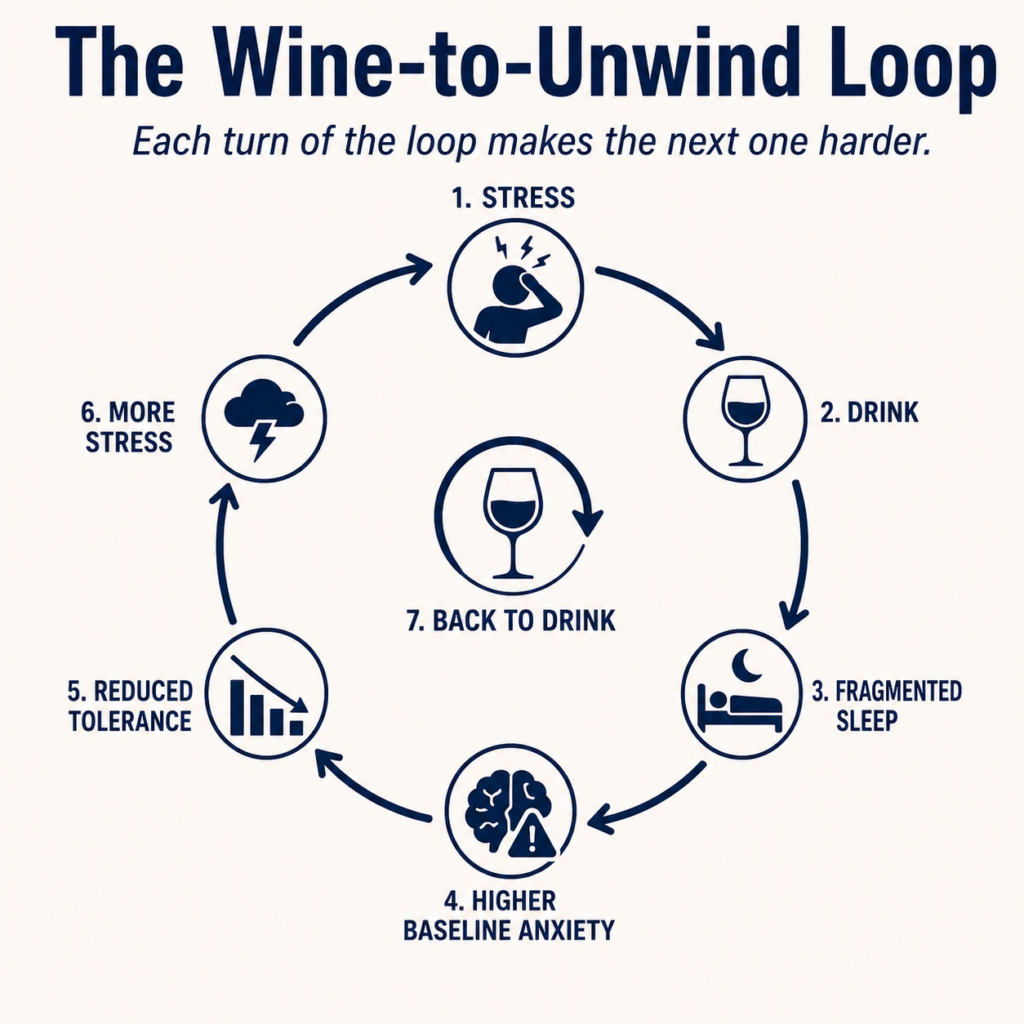
Alcohol works on stress through a specific brain mechanism. It enhances the effects of GABA, a neurotransmitter that quiets neural activity. That’s why a drink genuinely does help you feel calmer — you’re chemically dampening the parts of your brain that were firing anxiously. However, your brain doesn’t like being dampened externally. Over time, it adapts by reducing its own natural calming mechanisms, effectively assuming that alcohol will do the job.
The result is what researchers call “allostatic overload.” Your baseline stress level creeps up. You feel more wound-up between drinks. Situations that wouldn’t have bothered you before start to feel edgier. And the only reliable way to feel calm again — for a while — is the drink itself. This is not addiction in the clinical sense. It’s a much more common and subtle pattern that affects millions of moderate drinkers who never consider themselves to have a problem with alcohol.
This connects directly to a phenomenon that anyone reading this in their 50s or 60s may recognise: the sense that alcohol seems to affect you more than it used to. You’re not imagining it. Your brain’s ability to regulate its own stress response gradually erodes with years of alcohol-assisted coping, and the underlying anxiety — which the drink was masking — becomes progressively harder to sit with. As we’ve explored in our piece on how to reduce inflammation naturally, chronic elevated stress drives systemic inflammation, and that inflammatory state accelerates biological ageing across almost every system.
The Sleep Problem That Almost Nobody Connects
Here’s a pattern many people over 50 will recognise. You have a glass or two of wine in the evening — nothing dramatic — and you sleep. However, you wake at 3am, wired, unable to drift back off. You get up feeling foggy. You reach for coffee. By evening you’re tired, tense, and thinking about a drink. Rinse and repeat.
That 3am wakening isn’t random. Alcohol dramatically fragments deep sleep — the restorative slow-wave sleep during which your brain clears metabolic waste (including the amyloid plaques associated with Alzheimer’s), your cells repair, and your stress hormones reset. Even one or two drinks in the evening measurably reduces deep sleep duration. In someone using alcohol to cope with stress, the pattern becomes self-reinforcing: poor sleep worsens stress tolerance, which increases the urge to drink, which further fragments sleep. As we’ve explored in our deep dive on the importance of sleep for longevity, the biological cost of chronic poor sleep is genuinely substantial — and alcohol is one of the most common and least-recognised drivers of it.
What makes this particularly important after 50 is that natural changes in sleep architecture — including reduced deep sleep even in perfectly healthy adults — mean you have less resilience to absorb the disruptive effect of evening alcohol. What barely registered in your 30s is genuinely costly in your 50s and beyond.
What About the Cardiovascular Question?
For years, the idea that “a glass of red wine is good for your heart” had firm cultural hold. However, the evidence supporting that has quietly collapsed over the last decade. The best current analyses — including large meta-analyses that corrected for the methodological flaws in earlier research — find that even moderate alcohol consumption modestly increases cardiovascular risk, blood pressure, and stroke risk. The polyphenols in red wine that were once celebrated for their antioxidant properties are present in far greater quantities in foods that don’t come with the downsides of alcohol.
This matters because many people who wouldn’t dream of taking up smoking still feel that their nightly wine is somehow protective — or at least neutral. The evidence doesn’t support that framing. And when combined with the growing case that alcohol interacts poorly with the natural cardiovascular changes of ageing, it’s a conversation worth having with yourself, if not necessarily your GP. Speaking of which — if you’re on any cardiovascular medication, or considering the arguments around whether to start one, the conversation about alcohol probably deserves its own chapter. Our piece on the statin conversation your GP didn’t have time for covers some of the connected ground.
The Uncomfortable Truth About Moderate Drinking
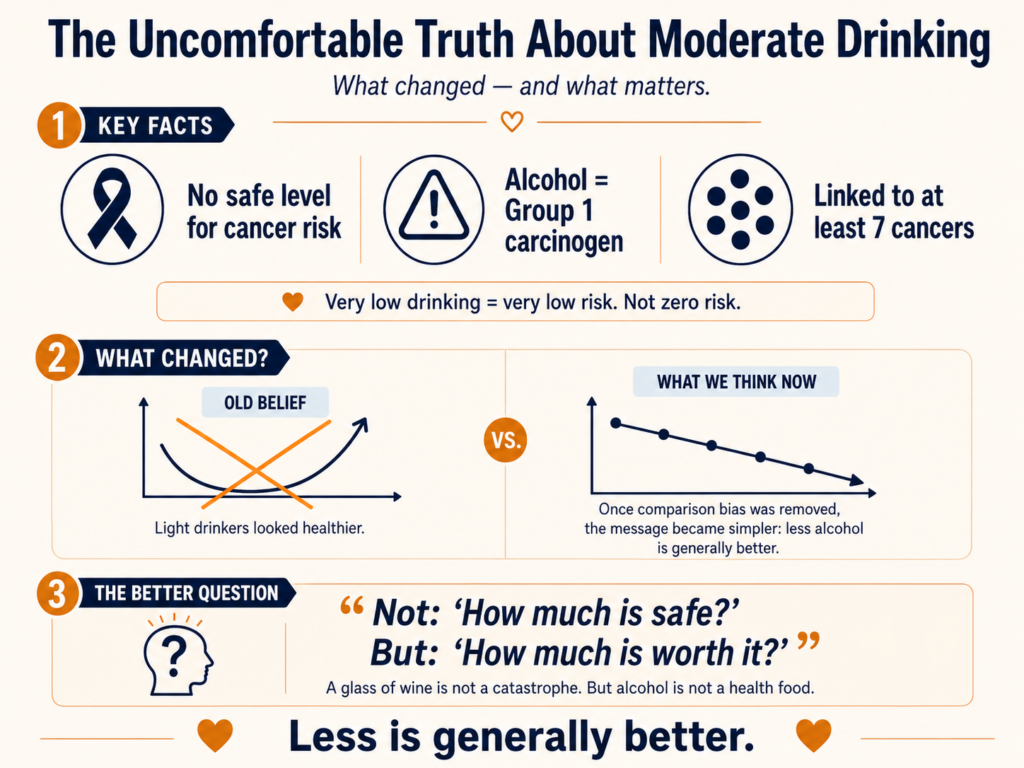
Some numbers worth knowing, because you rarely see them assembled clearly. The World Health Organization has now stated that there is no safe level of alcohol consumption for cancer risk. Alcohol is a Group 1 carcinogen — the same category as tobacco and asbestos — and increases the risk of at least seven types of cancer, including breast, bowel, liver, mouth, and oesophageal.
However, the risks operate on a spectrum. Very low levels of drinking carry very low levels of risk. What’s changed is that we no longer believe there’s a J-shaped curve — that light drinkers live longer than teetotallers. That statistical illusion turned out to be an artefact of comparing drinkers with “never-drinkers” who were often abstaining because of pre-existing health conditions. Once that confound was removed, the picture became simpler and more consistent: less alcohol is generally better, and the biggest gains come at the lowest levels of drinking.
None of this is to argue that a glass of wine at a family dinner is destroying you. It’s to say that the framing has shifted. The question is no longer “how much is safe” but “how much is worth it” — a subtly different conversation with a subtly different answer for each person.
What Actually Works for Stress — That Isn’t a Drink
Any article that suggests you rethink an evening drink without offering alternatives is fundamentally unhelpful, so here are the interventions that actually work — supported by evidence, and none of them requiring you to become a different person.
Movement, ideally in the late afternoon or early evening. Aerobic exercise reduces cortisol, releases endorphins, and improves sleep quality in a way that genuinely competes with alcohol for immediate stress relief. A 30-minute walk after work has a measurable effect on evening mood — and unlike a drink, it improves rather than damages your sleep. You don’t need to run marathons. You just need to move.
The 90-minute wind-down. The hour and a half before bed matters enormously for how you feel. Dim lights, no work, no news, no phone-scrolling — and specifically, no alcohol. Your brain has natural mechanisms for producing calm as it prepares for sleep; you just need to stop overriding them.
Genuine social contact. Real connection with people who know you well is one of the most powerful stress regulators available to humans — and it’s woven into much of the healthy ageing picture we cover in our piece on the role of social connections in longevity. A phone call with a friend, dinner with a partner without a screen present, a walk with someone whose company you value — these produce oxytocin and reduce cortisol in ways that no drink can match.
Breath work — specifically the extended exhale. This sounds like the sort of thing that appears in wellness magazines, but the physiology is genuinely robust. Exhaling for longer than you inhale (try four seconds in, six seconds out, for five minutes) directly activates your parasympathetic nervous system. It’s essentially a manual override for stress. Many people are surprised by how well it works when they actually try it.
Considering a temporary experiment. If your evening drink has become a habit rather than a choice, a 30-day break tells you an enormous amount about what alcohol is actually doing for you. Not a lifestyle change — an experiment. Most people report improvements in sleep, energy, and mood by week two that they weren’t expecting. Some go back to occasional drinking with fresh awareness. Some find they didn’t miss it as much as they thought they would.
| Stress Response | Short-Term Effect | Long-Term Effect |
|---|---|---|
| Evening glass of wine | Real relief within 20 mins | ⚠️ Rewires stress system, fragments sleep |
| 30-min walk after work | Moderate relief, mood lift | ✅ Strengthens stress resilience, improves sleep |
| Extended-exhale breath work | Strong immediate calming effect | ✅ Trains natural stress response |
| Genuine social contact | Strong emotional regulation | ✅ Independent longevity benefit |
| Wind-down routine (dim lights, no screens) | Gradual calming | ✅ Improves deep sleep significantly |
The Good News About Brain Recovery
Here’s something worth emphasising before the tone of this piece leaves anyone feeling defeated. The brain has genuine capacity for recovery. Research on people who’ve stopped or significantly reduced their alcohol intake — even after decades of heavy use — shows measurable improvements in brain volume, cognitive function, and stress regulation. Some of the physical changes that alcohol causes really are reversible. Not all, and not always fully, but the direction of travel is often more optimistic than people fear.
What the new UMass study adds is that this recovery isn’t complete or automatic. Some patterns — particularly the tendency to reach for alcohol when stress rises — appear to remain “wired in” even after long abstinence. That’s useful to know because it means recovery isn’t just about not drinking. It’s about actively rebuilding stress-regulation skills that alcohol was doing for you.
All of this sits within the broader work of slowing biological ageing naturally after 50. Alcohol isn’t the whole picture. Nutrition, sleep, movement, and social connection all matter. However, if there’s one lever you haven’t fully examined in your own life — and this article has quietly made you think about your relationship with alcohol — that would be worth sitting with.
FAQ — Things People Actually Ask
Is a single glass of wine with dinner really doing damage?
A single glass with dinner is almost certainly at the low end of the risk spectrum, and if it’s genuinely a source of pleasure rather than a coping mechanism, the balance of harm and benefit is genuinely close. What the new research is highlighting isn’t the drink itself but the pattern — using alcohol reliably to shift your emotional state. If your evening drink is celebratory and occasional, that’s different from a nightly stress-management ritual you couldn’t easily give up.
I’ve been drinking most evenings for years — is the damage done?
The evidence on brain recovery is genuinely encouraging. Studies of people who reduce or stop drinking show improvements in brain volume, cognitive function, and sleep quality — often quite quickly. What appears to persist longer is the pattern of turning to alcohol when stressed, which is why any change is more likely to stick when it includes rebuilding your natural stress-regulation skills, not just removing the drink.
What about the “no safe level” claim from the WHO?
The claim is accurate on cancer risk specifically. However, “no safe level” doesn’t mean “high risk at any level.” It means the risk curve doesn’t start at zero — it starts low and rises with intake. Very low levels of drinking carry very low levels of risk. What matters is being informed about the shape of the curve, and making choices that reflect what alcohol is actually worth to you.
What’s the single most important thing I can do this week?
Notice, without judgement, why you’re reaching for a drink each time you do. Is it a genuine social pleasure? A ritual you enjoy? Or is it a habitual response to stress, tiredness, or a difficult moment? Simply observing the pattern for a week — not changing anything, just noticing — is often the most useful first step. Change tends to follow awareness. Very little useful change starts before it.
One Thing to Do This Week
For seven days, note down every time you have an alcoholic drink and — this is the important bit — why. Was it social? Celebratory? A habit at a certain time of day? A response to stress? You don’t need to change anything. Just observe. At the end of the week, look at the pattern. Because the new research is really about one thing: the drinks we don’t think about are the ones most likely to be quietly reshaping how our brains handle everything else. Making them visible is the first step in reclaiming choice over them.
Want to Go Deeper?
If you want the wider picture of what actually moves the needle on healthy ageing — the sleep, the movement, the nutrition, the social connection — we’ve put together guides that cover it in a practical, evidence-led way.
Browse the full guides library at Slowing the Clock →
Take what’s useful. Leave what isn’t. That’s always the idea.