The Doctors Don’t Prescribe This — But the Research Says They Should
Your GP will talk to you about blood pressure, cholesterol, exercise, and diet. They will probably mention sleep. However, there is one factor that predicts how long you live — and how well — that almost never comes up in a ten-minute appointment. Not because it isn’t important. Because there is no pill for it, no referral pathway, and no way to bill for it.
It’s your social life. And the science behind it is considerably more alarming than most people realise.
⚡ What You’ll Learn in the Next 5 Minutes
- Why loneliness is as dangerous as smoking — and the data that proves it
- Why friend groups are quietly shrinking for most people over 50 — and why that’s not your fault
- The surprising difference between being alone and being lonely
- What “social connection” actually means for your biology
- Practical, non-embarrassing ways to build meaningful connection after 50
The Numbers Nobody Talks About
In 2010, researchers at Brigham Young University analysed data from 148 studies covering more than 300,000 people across multiple countries. Their conclusion was stark: people with strong social relationships had a 50% higher chance of survival over any given study period than those with weak or absent social ties.
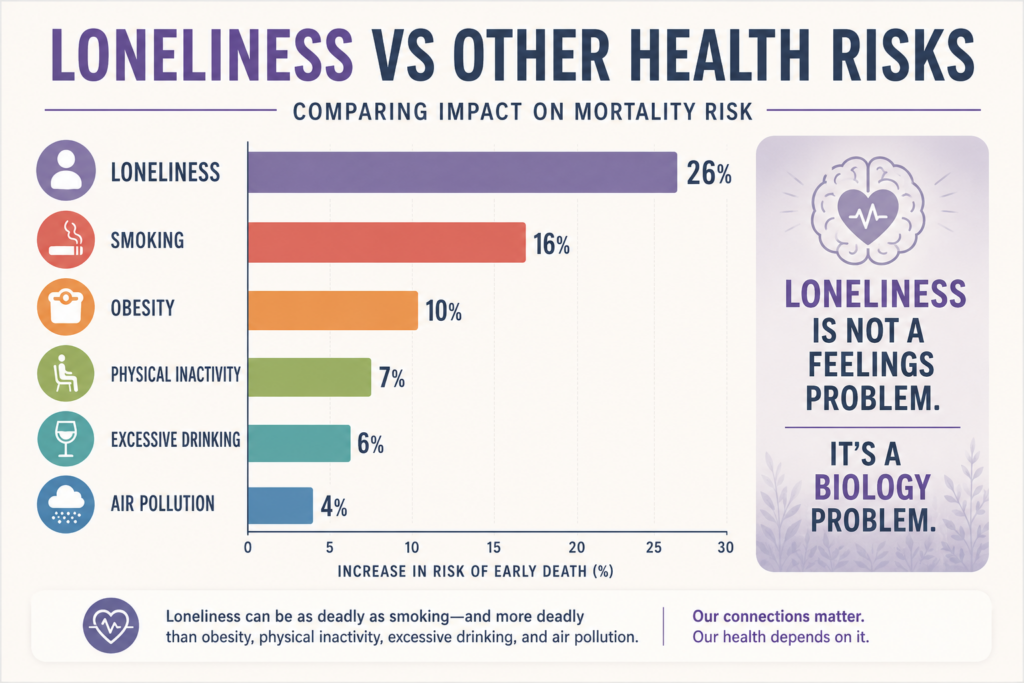
To give that some context: the mortality risk associated with social isolation is comparable to smoking 15 cigarettes a day. It exceeds the risk of obesity. It exceeds physical inactivity. It exceeds heavy drinking.
That finding has been replicated many times since. A major Harvard study tracking adults over 80 years found that close relationships — not wealth, fame, or career success — were the strongest predictor of health and happiness in later life. Julianne Holt-Lunstad, one of the leading researchers in this field, has described loneliness as a public health crisis of the first order.
Because here’s what chronic loneliness actually does to your body. It raises cortisol levels, which drives systemic inflammation — the same low-grade inflammatory state that accelerates biological ageing across almost every system. It disrupts sleep architecture, which compounds the problem further. It suppresses immune function. It increases the risk of cardiovascular disease, dementia, and stroke. As we explored in our piece on the importance of sleep for longevity, inflammation and poor sleep form a feedback loop that’s genuinely difficult to break — and loneliness feeds both ends of it.
This isn’t soft science. This is biology.
So Why Are Our Social Lives Shrinking?
In 2000, the American sociologist Robert Putnam published a book called Bowling Alone. His thesis was simple and troubling: since the mid-twentieth century, Americans had been withdrawing from civic life, community organisations, and social groups at an accelerating rate. People were, quite literally, bowling alone — where once they’d belonged to leagues.
The book was about America, but the pattern was global. And it has only accelerated since. The reasons are structural, not personal, which matters because most people quietly blame themselves for having a smaller social world than they’d like.
After 50, several forces converge at once. Children leave home and the social scaffolding that came with school gates and sports sidelines disappears. Careers wind down and with them the daily social contact of a workplace. Friendships that were sustained by proximity — the colleague you saw every day, the neighbour whose kids grew up alongside yours — quietly lapse when the proximity goes. Retirement, relocation, bereavement, divorce: each one can reduce the social world significantly, often without any conscious decision being made.
Technology promised to fix this. In some ways it has — it’s genuinely easier to stay in loose contact with more people than ever before. However, loose contact is not the same as genuine connection. Scrolling through someone’s holiday photos is not the same as sitting across a table from them. The research is fairly clear that passive social media use — consuming rather than connecting — is associated with increased loneliness, not reduced.
The result is that many people in their 50s and 60s find themselves with a social world that has narrowed considerably from what it once was. They are not isolated in any obvious sense. They are simply less connected than they need to be for optimal health — and the gap between where they are and where they need to be is larger than they realise, because nothing in daily life flags it as a problem.
Alone vs Lonely — An Important Distinction
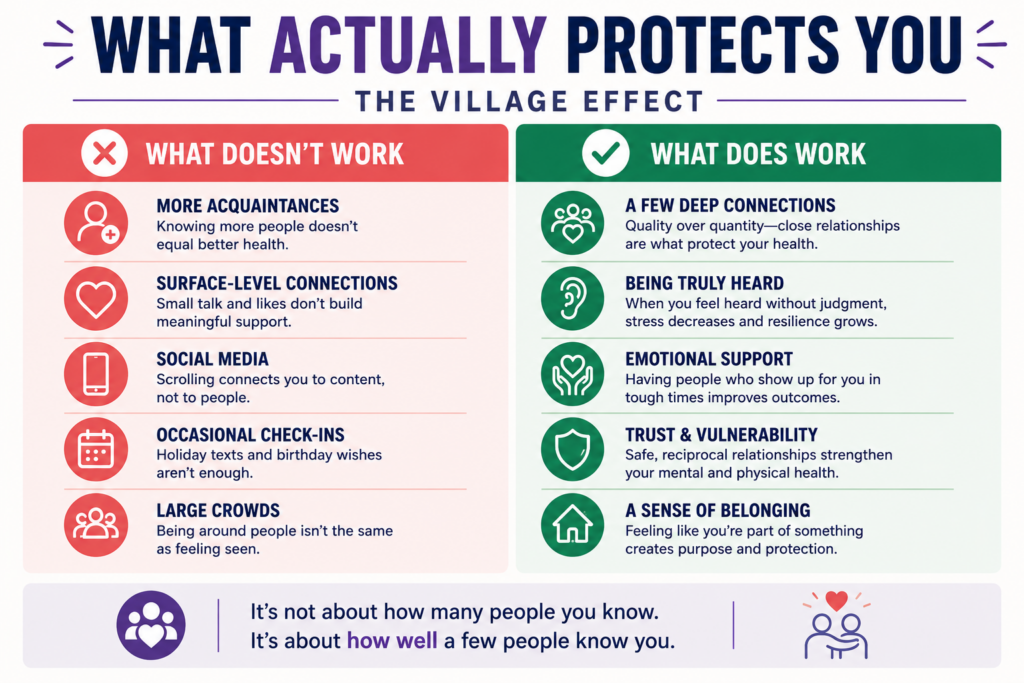
Loneliness is not the same as solitude. Some people live alone and thrive. Others are surrounded by people and profoundly lonely. What matters, biologically, is not the number of people in your life but the quality and depth of your connections.
Susan Pinker, in her book The Village Effect, identified what she called the “village effect” — the protective power of face-to-face contact with a small number of people who genuinely know you. Not hundreds of acquaintances. A handful of real relationships, maintained through regular in-person contact, that provide genuine belonging.
This aligns with what the Blue Zones research found. In Okinawa, one of the world’s longevity hotspots, older adults belong to moai — small social support groups that commit to meeting and supporting each other for life. These are not large social networks. They are small, stable, meaningful ones. That distinction matters enormously when thinking about what to actually do.
The connection between social bonds and your deeper sense of purpose is also worth noting here. People who feel genuinely connected to others tend to have a stronger sense of why they get up in the morning — and that sense of purpose carries its own significant longevity benefit. Our piece on finding and living your purpose explores that link in depth, and the two are harder to separate than most people realise.
What the Biology Actually Looks Like
When you have a meaningful conversation with someone you care about, your body responds in measurable ways. Oxytocin — sometimes called the bonding hormone — is released, which reduces cortisol and lowers blood pressure. Serotonin levels rise. Vagal tone improves, which is a marker of cardiovascular health and emotional regulation. Even brief episodes of genuine social connection trigger anti-inflammatory responses at the cellular level.
This is why the quality of relationships matters more than the quantity. A two-hour lunch with a close friend produces a significantly different biological response than two hours of messaging acquaintances. The body knows the difference even when we have convinced ourselves it doesn’t.
There is also a direct link to biological ageing itself. Chronic loneliness is associated with shorter telomeres — the protective caps on your DNA that shorten as you age. In other words, persistent social isolation appears to accelerate the ageing process at a cellular level. For more on how these biological mechanisms work, our guide to slowing biological ageing naturally after 50 covers the full picture.
The Comparison Worth Making
| Type of Contact | Biological Effect | Longevity Value |
|---|---|---|
| Close face-to-face relationships | Lowers cortisol, raises oxytocin, reduces inflammation | ✅ Very high |
| Regular group activities (class, club, volunteering) | Provides belonging, routine social contact, shared purpose | ✅ High |
| Phone / video calls with people who know you | Moderate oxytocin response, maintains close bonds | ✅ Moderate |
| Messaging / texting | Maintains loose contact, limited biological effect | ⚠️ Limited |
| Passive social media use | Often increases social comparison and loneliness | ❌ Can be harmful |
Actually Making Friends After 50 — The Honest Version
Nobody writes frankly about how hard this is. Adult friendship — especially for men, but increasingly for women too — requires initiating contact repeatedly before it sticks, being willing to feel slightly awkward, and accepting that the easy organic friendship-making of school and university is gone. That doesn’t mean it’s impossible. It means it requires something you probably weren’t told you’d need: deliberate effort.
The research on what actually works points to a few clear principles. First, repeated unplanned interaction is how most adult friendships form — which means putting yourself in situations where you will regularly see the same people. A weekly class, a running group, a choir, a book club, a volunteering role. The activity matters less than the regularity.
Second, self-disclosure is what moves an acquaintance to a friend — the gradual sharing of something real. This doesn’t mean being immediately vulnerable with strangers. It means being willing, over time, to move past small talk. Most people are waiting for someone else to do this first. Be the one who does.
Third, be the one who follows up. The research on friendship maintenance is unambiguous — relationships that are not actively tended lapse. A message after a shared activity, a phone call to follow up on something someone mentioned, an invitation to do it again. These small acts of initiation are disproportionately powerful because most people never do them.
You can read more about the stresses that chip away at social bonds — and what to do about them — in our piece on social stressors and their impact on health and longevity. It’s a useful companion to this one.
And if you want the full picture of what the research actually says about why relationships extend life, our deep dive on the role of social connections in longevity is worth an hour of your time.
FAQ — Things People Actually Ask
I have a small social circle but I’m happy with it — do I still need to worry?
Probably not. The research consistently shows that it’s the quality of your closest relationships that matters most, not the size of your network. If you have two or three people who genuinely know you, who you see regularly, and with whom you feel a real sense of belonging — that is genuinely protective. The risk comes when those close bonds are absent or have quietly eroded without being replaced.
I’m introverted. Does this apply to me in the same way?
Yes — and the good news is that introversion doesn’t require you to become someone you’re not. The protective effect of social connection doesn’t require a large or busy social life. It requires depth and regularity with a small number of people. Introverts often have exactly the kind of close, meaningful relationships the research says matter most. The question to ask isn’t “do I socialise enough” but “do I have people who really know me?”
I’ve lost people — through bereavement, divorce, or just drift. How do I rebuild?
Slowly, and with realistic expectations. Social rebuilding after significant loss takes time and often feels uncomfortable at first. The most useful frame is not “I need to find new close friends” but “I need to put myself in situations where connection can develop over time.” That means committing to regular activities with consistent groups of people, and giving it long enough — months, not weeks — for familiarity to build.
What’s the single most important thing I can do this week?
Identify one regular, in-person activity you could commit to — something weekly, with consistent people. It doesn’t need to be social in an obvious way. A gym class, a walking group, a local choir, volunteering, a community garden. The activity is just the vehicle. Regularity and consistency are what create the conditions for connection to form.
One Thing to Do This Week
Call — not message, actually call — one person you haven’t spoken to properly in the last three months. Someone you have genuine warmth for, who has probably drifted simply because neither of you initiated. Keep it short if you want. The point is the call itself, not its duration. Because the research on this is clear: relationships that are not occasionally tended simply fade. A two-minute phone call can restart something that matters.
Want to Go Deeper?
If this has resonated — and the chances are it has, because almost everyone over 50 has quietly noticed their social world shrinking — we’ve put together guides covering this and the other big longevity levers in one place.
Browse the full guides library at Slowing the Clock →
Take what’s useful. No pressure. That’s always the idea.